FILM, ART & MEDIA
Film analyses, creative reviews, art, photography & more!
TOPICS
Lens of Sustainability Photobook: Manchester, London & Paris
Documentary Film
Documentary Origins & Music Documentary Festival Reflection
Film Theory
Perception & Cinema, How Do We Make a Revolutionary Cinema?, Zabriskie Point
Genre & Individual Films
Art Cinema: The Double Life of Veronique and Chungking Express, Drunken Master II & DDLJ, Daisies, The Player, Le 400 coups, Polyester, The Princess Bride, The Peanut Butter Falcon
Lens of Sustainability Photobook: Manchester, London & Paris
Summer 2025
I had the amazing opportunity to travel to cities across the United Kingdom and Paris to learn about Sustainability through my university, UNC-Chapel Hill, and discover innovations in clean energy, policy, greener transportation, and sustainable urban redevelopment abroad. While there, I made sure to capture the sustainability and beauty of these cities in photos and below are just a few from my favorite 3 cities.
Scroll to view photos I captured from Manchester, London, & Paris!
Manchester

The Eden building, covered in over 350,000 plants!

View from inside the Eden

Rooftop view from the Eden

Gardens along Castlefield Viaduct, a viaduct uniquely converted into a public park
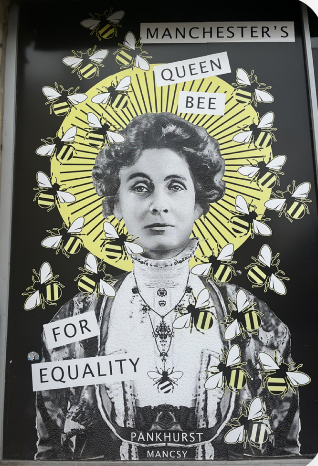
Manchester's Queen Bee, Emmeline Pankhurst, uniting women's suffrage advocacy with Manchester's worker bee symbol

More gardens along Castlefield Viaduct
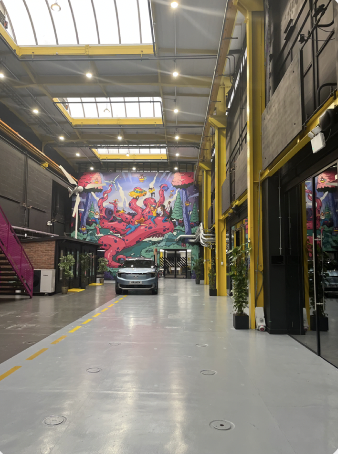
A visit to Octopus Energy!

Walking around Manchester Metropolitan University
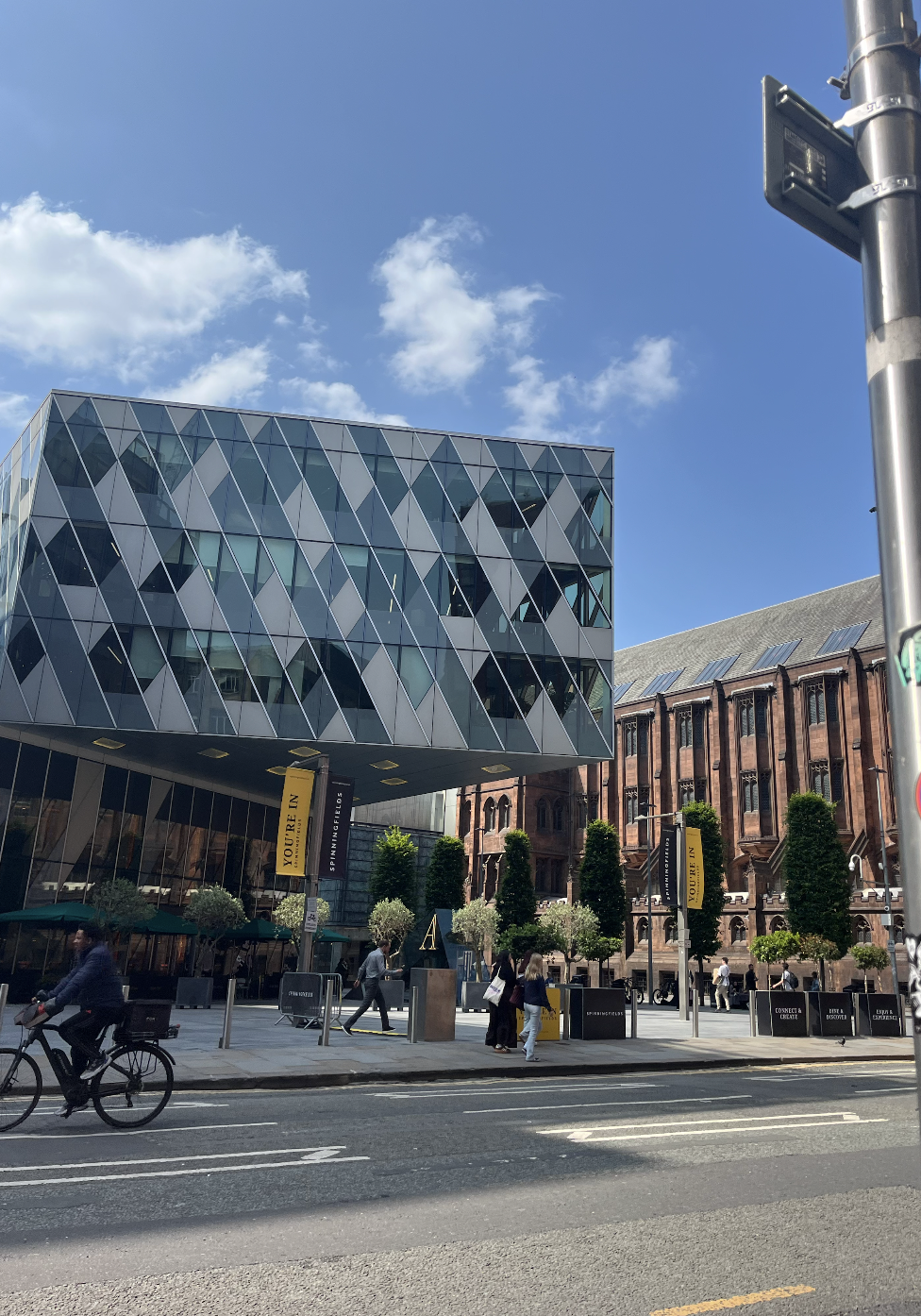
A city that blends the historic and the modern

Plant shops around every corner add color to the city

Basement of a local garden shop

Modern buildings blend in with the old
London

An art exhibition illuminating awareness for the melting of the Arctic due to climate change

Community events and posters live all around the city to promote the arts and local events

A bike ride to Buckingham palace, using eco-friendly transport to arrive at the Royal grounds

Attended the Global Offshore Wind and MOVE Conferences at the Excel Center

One of the many innovative booths for Global Offshore Wind at the Excel Center

A pop-up for the World Wildlife Fund at the Excel Center

Sustainability Ventures office in London

A visit to Sustainability Ventures, even the floors are made sustainably out of cacao shells
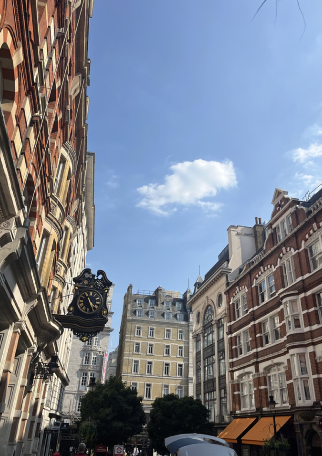
Beautiful views of historic architecture line the streets while the city buzzes with modern innovation

A visit to the Thames Barrier

Battersea Power Station

Notting Hill
Paris
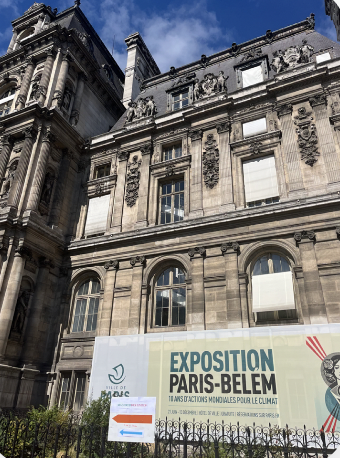
A climate exposition hosted for the summer
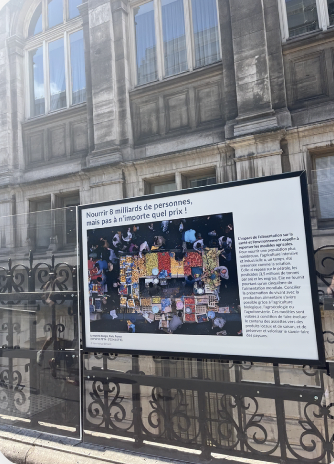
Murals lining the building with photos and descriptions of climate issues
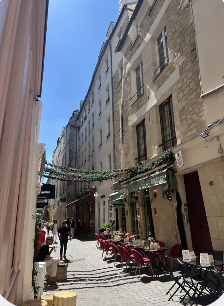
A walk down la rue des rosiers, a beautiful street with bakeries

Parks feature these signs promoting biodiversity of plant and animal life
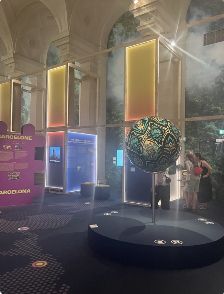
Inside a climate exposition with sections discussing different countries over the globe

The unique and modern architecture at the 17th arrondissement
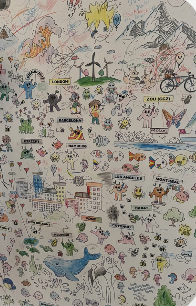
An interactive coloring wall at the exposition featuring animals
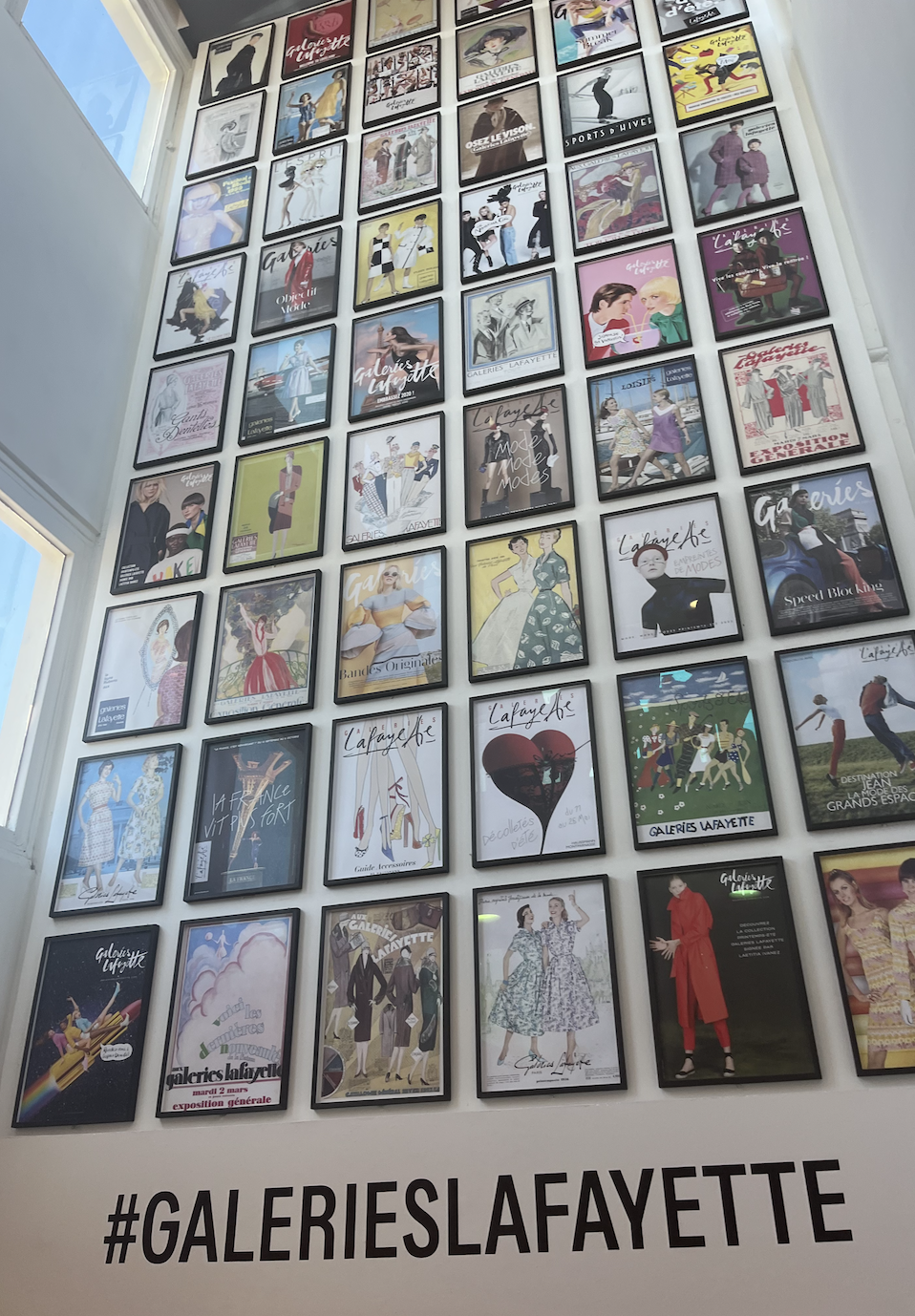
A visit to to the beautiful Galeries Lafayette Haussmann

A unique energy feature at the Paris Olympic Village

A view of la Seine which had been cleaned up to be up to swimming standards for July 2025
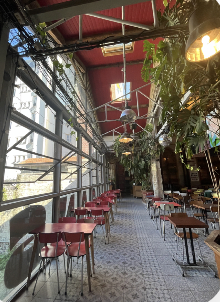
A visit to La Recyclerie, a sustainable restaurant, farm, and hobby space
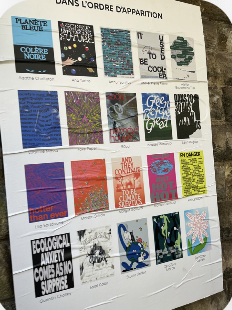
Film festival posters for a sustainability exposition at La Recyclerie
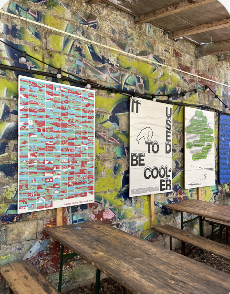
More posters to champion combatting climate change
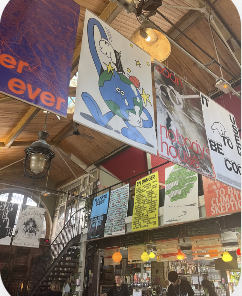
Inside La Recyclerie

More posters highlighting climate change and animal endangerment
Film Writing
As a film scholar through English and Comparative Literature, I’ve had the opportunity to write about film many times, from perspectives of critique, to theoretically analysis. I’ve explored the history of cinema, documentary film, a variety of genres, and have highlighted social themes. Below are just a handful of samples of my film writing.
Documentary Film
Scroll to explore my writing in documentary film!
Documentary Film: Origins, Debating the Griersonian Documentary & Resistance and Liberation
Mar 2024
ORIGINS
In considering the historical origins of the documentary and both preceding and proceeding non-fiction media, there is clear potential for the proposition of a new history and definition of documentary film. Regarding what’s new about Nanook of the North and other 1920s films such as Simba and Grass, there is reason to consider the intentions of these early works, the role of the camera, and the social, cultural and political messages these films transmit.
Film historians have long considered Robert Flaherty’s 1922 film, Nanook of the North, as the first documentary. However, under modern reevaluation there is potential to revoke that label and rework how we understand the film and its ramifications. Since its release, criticisms of Nanook include its manipulation of characters and narrative as well as its misrepresentation of the Inuit culture through a Western gaze. It’s crucial to consider Nanook’s lack of faithfulness to complete truth in favor of entertainment through crafted narrative and depicting the overarching circumstances of life in the Arctic. The film reveals a Western goal of discovering the world and exigence for documentary in terms of sharing that discovery with audiences through film. In a similar spirit for discovery imbued with an imperialist spirit, Johnsons’ 1928 film, Simba, further reflects ethical concerns of documentary, in this case, the camera documenting the killing of a rhinoceros in Kenya. The camera and filmmaker act as accomplices to the poaching occurring on screen. This calls into question the ethical ramifications of portraying violence perpetrated by colonial forces in Africa and exemplifies where the Western worldview directly affects the documentation of a place of discovery for Western audiences. However, Cooper and Schoedsack’s 1925 film Grass portrays qualities that are somewhat more redeemable to modern ethical criticism. The film chronicles explorers in Iran following a migration during a time of colonialism. Although it includes a faked sequence and the focus on the explorers is debatably ethical, this film represents a way of discovering part of the world in a tone more geared toward education than entertainment via character constructions or imperially motivated violence.
These early documentary films from the 1920s share commonalities with older models of nonfiction media such as travel films from the 1910s and works from the Lumiere brothers which present a similar drive for global discovery catalyzed by a desire to bring the world to audiences through film. Conversely, the documentaries of the 1920s place emphasis on narrative and characters, paralleling fiction films, and stronger notions of intruding into an environment. These films don’t simply portray stand-alone imagery of landscapes as in earlier travel films, but convey cultural and political issues as well as the filmmakers’ own place and goals within those spheres. Travel was no longer the main objective, rather crafting intriguing stories based on actuality funneled through Western cultural ideas took prominence in 1920s documentaries.
In expanding the history and definition of documentary to include earlier nonfiction films we gain a sense that documentary covers a wider umbrella of all nonfiction films including 1910s travelogs and Lumiere travel films. Simultaneously, we lose the idea that documentaries followed after the origin of cinema and instead assert documentary as the original film practice, presenting the idea that documenting the truth of the world was the primary exigence of cinema. Delineating the origins of documentary broadens what we accept as documentary throughout its history and motivates a reconstruction of the original impetus of cinema. There is potential to both redefine the catalyst for the creation of cinema as striving to reflect the world and evaluate how that permeates in documentaries throughout history and films universally.
DEBATING THE GRIERSONIAN DOCUMENTARY
By the 1930s, the Griersonian style of documentary defined by “the creative treatment of actuality” (Grierson) had reached dominance. Grierson sought not only to display the reality in front of the camera, but portray larger social conditions through documentary films. However, the Griersonian style of documentary has been criticized for its tendency to produce propaganda based on production sponsorships and misconstrue a reflection of reality by using filmmaking techniques to artfully frame narratives. In contrast, cinema verite, a French film movement originating in the 1960s, sought to reveal reality in a raw, self-aware manner rather than heavily apply aesthetics. In considering both Griersonian documentary and cinema verite, there are examples of each that showcase successes and failures in resolving the tension between aesthetics and authenticity. However, overarchingly, cinema verite tends to achieve a greater proximity to truth for its greater emphasis on simpler immediacy to reality as opposed to Griersonian documentary’s pattern of producing propaganda and bending the truth through aesthetic and narrative construction.
A popular Griersonian film, the most famous from the United States government, is Pare Lorentz’s 1936 The Plow that Broke the Plains. Commissioned by the New Deal, this film focuses on the history of the Plains and presents information through the film techniques of montage and voice-over narration. The aesthetic sensibility produced by these film techniques reinforces American values, both subtly and by directly echoing the sponsorship of the United States government and its Dust Bowl recovery efforts. Poetic voice-over narration, including the repetition of phrases about weather conditions in the Plains, rhetorical remarks to imagined characters on screen, and slogans in relation to wheat securing victory in WWI, perpetuate sympathy for protecting the Plains as well as nationalism. Charles Wolfe points out in his essay “Straight Shots and Crooked Plots: Social Documentary and the Avant-Garde in the 1930s” how rhythmic montages in this film evoke analogies and metaphors. He states, “...tractors are likened to tanks, and grain spouts to cannons…A connection between economy and ecology is then sealed.” (Wolfe, 240). Aesthetics and editing techniques connect farming wheat to war victory, revealing how the symbolic match-cutting of images parallels politics to ecology. This emphasizes the government initiative to protect the Plains for a victorious American future full of wheat production. Through montage, The Plow That Broke the Plains uniquely relates nature to social conditions, thus succeeding at reflecting the reality of a confluence of factors during a historic moment in American history. It’s difficult to picture an alternative way of presenting various events happening at once without montage linking them together so intimately. However, although the Griersonian techniques of this film support the historical reality it aims to portray, the sponsored nature of this film perpetuates an American nationalistic agenda, both subtle and poetic, and thus imbues truth with bias rather than purely reflecting actuality.
The 1960 film Chronicle of a Summer directed by Jean Rouch and Edgar Morin exemplifies cinema verite at its origins. The film features a sociological study on the streets of Paris in which one of the filmmakers interviews everyday people about their happiness. The film exhibits the reflexivity of cinema verite as the filmmaker stands onscreen directly addressing the interview subjects. Moreover, the film concludes with the unique ending of the subjects watching the film that the audience had just seen so far. Reflexivity in this mode of documentary creates an open space for constantly questioning and pursuing reality. This contrasts the Griersonian documentary which tends to present reality as emphatically true through an omniscient offscreen and anonymous presence of the filmmaker. Chronicle of a Summer successfully captures the reality of how everyday people behave, but this reality arrives within the format of a sociological ethnographic study which brings into question the effect of this study and the camera on influencing subject behaviors. However, the direct address from the subjects about this concern presents cinema verite’s reflexive self-awareness about the complexity and contradictions that exist in the midst of striving to reflect raw reality in documentary film. Where this film potentially interferes with reality, it employs reflexivity to address and assuage that concern. This connects the film to a deeper sense of revealing the truth to audiences, paralleling the discovery of truth that the filmmakers and participants within the film strive to achieve.
In comparing Griersonian documentary to cinema verite, Griersonian documentary’s aesthetics compellingly appeal to emotions while a greater emphasis on aesthetics and production sponsorships sway its portrayal of reality. Although films such as The Plow That Broke the Plains successfully illuminate a truthful history, Griersonian documentaries that reflect social issues and their sponsorships perpetuate particular worldviews and therefore act as propaganda by promoting nationalism. Cinema verite, as exemplified by Chronicle of a Summer, exhibits a disinterest in political motives and rather curiosity to allow reality to unfold before the camera as naturally as possible with self-reflexivity regarding the awareness of factors that interfere with that. In this style of documentary there is less tension between aesthetics and actuality than in Griersonian documentaries due to a lack of focus on aesthetics in favor of rawness and reflexivity. Thus, cinema verite’s tension between aesthetics and actuality tends to be smaller than in Griersonian documentaries. Despite the Griersonian documentary’s successes in compellingly presenting social conditions, aesthetics that are motivated by sponsorships in particular imprint ideologies onto actuality resulting in a greater tension between aesthetics and actuality in the Griersonian model than in cinema verite.
RESISTANCE & LIBERATION
Since the 1960s, documentary filmmakers have developed a wide range of film techniques to implement the medium for criticizing nation-states and other large institutions. The emergence of various film techniques challenges our association between documentary and truth by calling attention to their potential power.
Peter Watkins’ 1965 film The War Game utilizes film techniques to mimic the Griersonian style of artistically approaching reality. Watkins’ controversial film features a reenactment of a potential future of nuclear devastation in Great Britain, serving as a warning to the public of their danger. This documentary exposes Watkin’s belief that it’s the task of the filmmaker to expose what’s protected by national security, in this case, the usage of thermonuclear weapons. The War Game provides the audience the knowledge to decide their stance on the use of these weapons during a time when there was an undemocratic distribution of information about them otherwise available to the public. The aesthetic choices of this film include dramatic scenes of burning towns, close-ups of burned limbs and faces, and haunting narrations, all of which achieve emotional poignancy. There is a paradoxically strong sense of reality in the reenacted portrayal of a fictionalized future as the film echoes the present-time prolific concern over nuclear weapons as manifested images. The War Game intensely criticizes the usage of nuclear weapons and advocates for the public to be better informed. By staging an imagined horrific future if nuclear weapon usage were to end terribly wrong, Watkins suggests that the English government has the potential to misuse nuclear weapons and ruin the nation. This is a highly anti-nationalistic message which directly blames the English government through usage of the strong power of aesthetics and narrative choices that are emblematic of the socially-cognisant Griersonian documentary.
Another film that criticizes the nation-state, particularly police, is Padhila and Lacerda’s 2002 film, Bus 174. The film features the event of a young man, Sandro Nasciemento, who hijacks a bus in Rio de Janeiro. The film explores his story, the police response, and criticizes the failure of state institutions in Brazil to provide justice for those like him on the social outskirts. The film emphasizes a critique of the state through aesthetic choices and its use of conventional documentary filmic strategies such as interviews and an expository style. The aesthetics of Bus 147 contrast the cameras that swarmed the bus hijacking during the 2000 event with the overarching social theme about the invisibility of youth in Brazil. The opening shot, an aerial view of Rio that slowly lowers to the slums, sets the stage for a sense of misrepresentation and desire of the film to expose those who are invisible in Brazilian society. The narrations that accompany this opening further convey surveillance as an aerial shot covers a wide ground and invisibility is conveyed via offscreen voices. Additional aesthetic choices call attention to broader social issues out of which Sandro’s story and bus hijacking emerged. The technique of slowly bleeding color into a black and white image to focus on a particular figure, Sandro, visually represents how Sandro’s plight is microcosmic of broader social and economic issues in Brazil. The yellow tone presents a sense of sickness and dirtiness exhibited in the slums and the slow motion shots, such as one featuring a cop running with a gun, immerse the viewer in the position of a Brazilian youth being chased. Furthermore, the usage of conventional documentary strategies such as interviews and archival footage grounds the film in truth, connecting the aesthetic liberties that evoke the broader issues in Brazil to the locus of the bus hijacking event.
A more current film that reflects political criticism is Rachel Lear’s 2019 film, Knocking Down the House. The film follows four candidates and their grassroots campaigns against longrunning incumbents in Congress during the 2018 democratic primary. Through a style of direct cinema, the film provides an intimate look into the candidates’ campaigns and the making of political power. The camera acts as a fly on the wall, documenting a behind-the-scenes look into the candidates and their campaigns, thereby unmasking the private reality of which most people never know about. Scenes set at candidates’ houses, tight shots with shaky camerawork, and live sound recording all anchor the film in an intimate sense of actuality. This brings the audience closer to the candidates, making them feel more connected to them and their campaign journeys. Through the style of direct cinema, there is a heightened sense of providing a democratic lens into a political race when such an intimate look at the experience for the candidates would never have existed at previous points in history, even through other styles of documentary. In earlier eras, audiences would never see a congressional candidate casually sitting in their living room describing what they dislike about an incumbent’s campaign. Knocking Down the House uses direct cinema as a conduit for candidates to speak freer than in other formats such as interviews, enabling them to comfortably voice their criticisms of incumbents and American politics. The sense of rawness achieved through techniques of direct cinema increases an honesty that juxtaposes the distrust and fakeness we often associate with politics. Knocking Down the House powerfully uses direct cinema film techniques to provide an unembellished window into the realities of a historic Senate race and critical insights between candidates about each other, incumbents, and the United States and its institutions as a whole.
In reviewing three films made after 1960 that critique the nation-state and other institutions, there is a sense that documentary serves the role of not just portraying the truth in front of the camera, but unveiling broader social and political realities. This unveiling process relies on the ability of the filmmaker to connect various dimensions of social truths and critiques of nation-states through imagery, sound, and themes. The techniques featured in each of these films imbues them with more power by emphasizing the truths that they seek to reveal.
The emergence of a plethora of filmmaking techniques exhibited at various points in time in these three films predicts a future of documentary with continuously new film techniques that will likely coincide with social, political, economic and technological changes. What counts as documentary has the potential to broaden as well. With the advent of social media, people have been documenting their lives for years now, although the versions they present online are subject to scrutiny in regard to authenticity. Videos on TikTok that document a person’s life, typically autobiographically, such as a look into what they did in a day or them sharing how they met their partner, could potentially count as documentary. Regarding the growth of social media and subsequently content-creators, there is potential to label a plethora of content as documentary. With ever-changing social and technological climates and increased media production and consumption, the future promises evolutions in film techniques and documentary styles in parallel to an expanded meaning of documentary itself.
Music Documentary Film Festival Reflection
Apr 2024
“Adventures in Music: Carrboro Film Festival” : Concert Films and Cultural Movements
Engaging in our class film festival and curating a film festival proposal for culturally-momentous concert films with my partners deeply broadened my knowledge by illuminating the myriad facets of festival production and reception. During my experience with my group curating our festival, I encountered how film festival development takes on a similar force in cinema akin to a director’s indelible imprint on a film. While choosing our film lineup, planning the schedule, selecting locations in Carrboro, and forging thematic connections among our films, I discovered the layered creativity in film festival development. In the following, I explore my experience generating my portion of the film festival from my group “Adventures in Music: Carrboro Film Festival.” Our festival features concert film documentaries organized into three days centered on different themes with day one focused on the live moment, day two centered on cultural movements, and day three diving into fanbases. We divided screening locations into interactive and walkable spaces in Carrboro - the Carrboro Arts Center, Carrboro Town Commons, and Weaver Street Market, to mirror the movement and ambiance of a film festival. The audience’s ability to walk around and view these films in lively, community locations breaks the constructs of a typical theatrical setting in which the expectation is darkness and silence, thus providing an experience different from which most of our audience would be familiar. This aspect of immersion and interaction facilitates the notion that the audience is just as fundamental a force in shaping the film festival as the cinematic experiences.
I led the second day of our festival about cultural movements in concert documentaries by exploring how concert films reflect and shape culture. These films collectively feature film festivals, concerts, and tours while showcasing cultural changes exhibited in politics, technological innovations, and social changes. I focused Day Two on five films that we felt most closely aligned with cultural movements despite how we recognize thematic overlap between films and themes of the different days of our festival. I ordered the films based on our group’s desire to provide an “adventure” through music as a journey through different times and spaces without the rigidity of a linear temporal order. This mirrors how music, like film, is a timeless medium capable of moving people from its time of creation and beyond as it evolves and takes on new meaning to new audiences. In analyzing my selected films, I noticed that many of the directors employed the similar documentary techniques of featuring live or archival footage of the concerts and the audiences as well as sit-down interviews. The aesthetics tend to rely less on the directors' styles and more on the aesthetics that pre-existed in the performances and audiences as the camera merely captured the styles as they were rather than imposing a heavy-handed directorial imprint. However, the editing of these musical documentaries tends to parallel music with a lyrical and rhythmic quality. Additionally, when the camera holds an audience-akin perspective, the films tend to be imbued with a sense of celebration whereas films that feature the artists' perspectives tend to impose a greater sense of realism. Thematically, I discovered that many of these films exhibited youth culture, specific locations as centers for cultural movements, challenging politics, and unprecedented fame ushering in new ideas about music in popular culture.
The first film of the second day of our festival program is “Monterey Pop” directed by D. A. Pennebaker from 1968. Pennebaker captures the two-day Monterey Pop Festival in the summer of 1967 and the spirit of the counterculture movement, featuring performances from the Mamas and the Papas, Jefferson Airplane, the Who, Simon & Garfunkel, Otis Redding, Janis Joplin, Jimi Hendrix, Ravi Shankar and others. While highlighting the artists’ performances, this documentary often cuts to footage of the audience in attendance and the festival activities they engaged in. Both the artists and the audiences reflect the hippie ideals of the time through dress, music, and partaking in psychedelic drugs. The motifs associated with psychedelic drugs are expressed in the aesthetics of the festival and occasionally in filming style, such as with clips that play with the reflections of colorful glass or shots of the backdrops of the stages that feature rhythmic patterns of fractal-like shapes.
Notably, this concert documentary and the festival it embraces hold the power of cementing California as the epicenter for hippie culture. The idealization of California as the focal point for hippies appears not only in the title of the festival and the film as it took place in Monterrey, California, but also in the music they both feature. Along with a live performance of the song, the soundtrack features “California Dreamin'' by the Mamas and the Papas as well as the song “San Francisco'' by Scott McKenzie, written intentionally for the film, which promoted California as the home for hippies. The celebration of California for the counterculture movement conflicted with how residents of Monterrey initially opposed the festival due to differences in political beliefs. Yet, the Monterey Pop Festival successfully took place, featuring many artists, uplifting many of their careers, and spurring more support and popularity for the counterculture movement which the documentary “Monterey Pop” has historicized. Pennebaker’s film encapsulates the spirit of this festival as part of the Summer of Love and the counterculture movement as a whole on the permanent medium of film, thus permanently preserving the cultural waves created by the festival’s musicians and attendees and allowing this historic moment to live on.
The next film for Day Two, “The Beatles: Eight Days a Week” directed by Ron Howard in 2016, retroactively dives into the meteoric rise of The Beatles, chronicling their touring years until their last performance in San Francisco in 1966. Howard tells the story of The Beatles through a collection of archival footage of concerts, the crowds swarming the band’s arrivals in new cities, and interviews of the band members from over the decades with recent sit-downs with Paul McCartney and Ringo Starr. Howard captures The Beatles’ unprecedented level of popularity and “Beatlemania'' with concert footage featuring the audience’s visceral reactions to the band and footage of fans swarming the band in public. Footage of city officials discussing new measures to enact due to the sheer volume of Beatles’ fans gathering during tour stops further speaks to the “Beatlemania” phenomenon. Informative segments about the culture and politics of the 1960s in the United States illuminate how the baby boomers’ comprising the largest portion of the population, many of whom were teenagers in the 1960s, looked to popular culture and identified with The Beatles, thus making-up a large portion of their fanbase. This level of “mania” in music and popular culture as a whole during The Beatles’ 1960s global takeover had yet to be attained by any artist or band before. As such, “The Beatles: Eight Days a Week” heavily touches on the price of this unprecedented fame as it was experienced by the band members. Emphasis on their discontent with being “on” all the time, “eight days a week” as the title evokes, arrives with interviews from the band members speaking about their desire to simply focus on their music, not on being celebrities. A dive into the music they created after their last show on tour in San Francisco in 1966 reveals the heart of what The Beatles stand for in terms of ultimately wanting to be in the studio evolving and experimenting in music. Against the odds of no longer touring, Howard’s documentary highlights their ability to release what Rolling Stone considers the greatest album of all time: “Sgt. Pepper and the Lonely Hearts Club,” as well as many other hits.
The film encapsulates the politics of 1960s America by identifying events such as President Kenney’s Assassination, segregation, and the Civil Rights Movement. The Beatles, who originate from a different political landscape in the United Kingdom and hold personal political views, notably refused to play segregated shows in the United States, signifying the power of a musical group to refuse to perform at a touring location due to political defiance. The band’s desire to play for “people,” and never consider race as a factor in their fan base speaks to The Beatles’ ability to appeal to a wide diversity of listeners which further reigns true in their appeal to people across space and generations. The Beatles have appealed to those all over the world for decades and have remained a cornerstone in music history and popular culture as a whole. No other band or artist before The Beatles had ever experienced their type of fame, of “mania,” and this documentary solidifies a point in which a particular zeitgeist could catapult a band not only into the stratosphere of the music industry, but into the heart of popular culture and still beat in our current musical collective consciousness. Thus, Howard’s documentary imparts how a cultural movement, sparked by support from a radically huge and diverse fanbase, can be signified by one musical entity who holds the power to unite people across time and space in a way far greater and different than any other force in the world.
The third film I focused on is “Never Say Never” directed by Jon M Chu in 2011 which provides a behind-the-scenes glance into Justin Bieber’s preparation for his sold-out performance at Madison Square Garden. This documentary features home footage filmed by Beiber’s mother of him growing up and exploring his musical talent in a small town in Canada as well as archival YouTube footage of his playing which his mother initially posted for family members to see. This documentary highlights the power of YouTube in launching Beiber’s career as it was Scooter Braun stumbling upon his videos which impassioned him to become Bieber's manager. The idea that social media can launch an artist has ushered in a new era of pop stardom which is frequently exhibited in modernity as many pop stars have and continue to reach fame through social media platforms. Concert footage makes up the heart of this documentary, capturing Bieber's performances throughout his setlist at Madison Square Garden, while emphasizing his talent as a vocalist, drummer, and dancer. Footage of his fans before and during the concert echoes the “Bieber Fever '' phenomenon through their star-struck pre-show anticipations and reactions during the show. A young male artist capturing the attention of young female fans isn’t a new phenomenon, but the scale of Justin Bieber's “Bieber Fever'' calls into question just how he managed it. “Never Say Never” suggests through footage of Bieber using Twitter on his phone how Beiber’s use of novel social media had enabled him to foster a closer connection to his fans, thus feeding their obsession to a scale that no other prior technology could achieve. Furthermore, Justin Bieber's ethos of “Never Say Never,” the title of one of his biggest songs and Chu’s documentary, conveys the message of never giving up on your dreams which had inspired Bieber's fans who share that sentiment in interview clips before and after the concert. The documentary concludes with Justin Bieber's performance of “Never Say Never” and thus epitomizes the narrative that if a young boy from a small town in Canada can post YouTube videos and reach such global fame that propels him to perform at the iconic Madison Square Garden at the start of his career, anyone else can achieve their dreams too if they have the merit. Justin Bieber set the example for an entirely novel type of pop stardom in popular culture from the late-2000s onward, yet he has simultaneously remained at the top-tier of pop status which reflects how culture, similar to the case of The Beatles, can launch an artist into the stratosphere and make a legend of them early into their career, despite how the means and politics of Justin Bieber's ascent were quite different from any other artist in the history before him.
The fourth film of Day Two, “Jazz on a Summer’s Day,” directed by Aram Avakian and Bert Stern, is the first film in color to portray jazz performance, capturing the Newport Jazz Festival in 1958. Avakian and Stern highlight the performances of artists such as Louis Armstrong, Mahalia Jackson, Stony Stitt, Thelonious Monk, and Anita O’Day. The festival curators were an interracial couple who intentionally provided the opportunity for a diverse lineup of artists to play at the festival, celebrating and giving the stage to pivotal members of the world of jazz. In the late 1950s, Newport, Rhode Island served as a location somewhat isolated from segregation in the South and heated racism throughout the United States. Juxtaposed with performances, the directors include intercuts of the New England seaside city through images of summer leisure portrayed in sailing, dancing, and beaching. By overlaying jazz music from the festival performances with rhythmic and lyrical images of sailing and dancing, the directors align jazz with the gaze of a New England summer. While Newport, Rhode Island was a predominantly white, wealthy town, the directors infused jazz music played by non-white artists with the landscape and soundtrack of Newport. This documentary celebrates jazz music and moving towards political progress, yet, it reveals a palpable tension between the wealthy whiteness of the town and the political call for a more diverse array of artists on stage and in popular music as a whole. Avakian and Stern’s documentary effectively portrays the idea that a music festival and its documentation can promote social change and allow a genre of music in particular to widen social acceptance of a minority group. The documentation of the Newport Jazz Festival on the film medium holds a permanent record of short-lived performances, holding the power of historicizing the festival as a turning point in jazz music in the late 1950s.
The final film I dove into for the second day of our festival is “Hype!” directed by Doug Pray from 1996 which provides a look into the explosion of the grunge scene in Seattle during the early 1990s. The film chronicles the emergence and rapid popularity of grunge in Seattle through archival footage and interviews with bands in the early 1990s. Pray conveys the narrative of Seattle being a rainy nowhere-land where youth around the mid-1980s sought ways to express their bottled-up energy, with the answer happening to be underground music venues. Youth in Seattle in the mid-late 1980s desired unpretentious music that they could thrash around to as a means to feel livelier in a bleak town. Similar to other genres of music like punk rock of the 1970s, seeking a source to express an exaggeration of emotion through music, dancing, and crowd-surfing arrived in the form of grunge music, a genre known for its dramatic darkness yet self-aware absurdity. Archival footage documents the grunge scene by following concerts from lesser-known bands from the mid-1980s until Nirvana to capture the genre's evolution. “Hype!” features interviews and behind-the-scenes footage of bands including Pearl Jam, Soundgarden, and Mudhoney, as well as the founders of Sup Pop responsible for marketing grunge to reach widespread popularity. The making of this documentary in 1995 and 1996 comes right after Kurt Cobain’s death which shadowed uncertainty about the future of grunge with the tragic end of Nirvana, the most notorious band to come out of Seattle. Footage of Kurt Cobain’s memorial illustrates how impactful Nirvana and his death were to his fanbase and to Seattle as a city, which evokes the potential for a visceral tie between origin and an artist in relation to their fanbase. Interestingly, audiences who view the film in 2024 have the prospective perspective that Seattle is no longer a hot spot for emerging grunge artists, however, modern audiences recognize grunge’s success, especially in the legacy of Nirvana, and a new generation has been able to forge a close connection to grunge music despite the divide of time and space.
“Hype!” serves as a documentary that demonstrates the ability of a location to become the epicenter of a music movement which can easily translate into a cultural movement or “scene” and be expressed in other mediums such as in “grunge” fashion and in non-conformist identities. Sub Pop’s capitalizing on grunge calls into question the tension created when a marketing company commercializes music that originated for an underground scene. “Hype!” doesn’t dive too deeply into this idea and positively illustrates how Sub Pop put grunge and Seattle on the map. However, the end of the documentary explores what “grunge” means and why the grunge scene lasted so briefly, though typically attributed to Kurt Cobain’s untimely death. “Hype!” evokes how a cultural movement, even short-lived, in a particular place can radiate across the world via a company marketing and selling music that speaks to a united musical desire within not only a “nothing-to-do” city, but for listeners across the globe. The pattern of youth seeking music to resonate with them outside of the mainstream popular culture became especially poignant by the 1990s, however, grunge paradoxically became mainstream. This phenomenon implies that perhaps the music isn’t the only “mainstream” aspect of this movement, but rather, what young audiences in particular sought, in reaction to environmental forces such as boredom in their city or resistance to conformity, is a universal quality in and of itself that mirrors the ethos of grunge as a means of expression and source of liberation.
In preparing, viewing, and analyzing these five concert films that I found all speak to particular zeitgeists, I discovered thematic crossovers in how concert film documentaries operate in portraying cultural movements. The notion of unprecedented fame, its effect on youth culture, and its legacy for future generations appears in “The Beatles: Eight Days a Week,” “Never Say Never,” and “Hype!” with respect to Nirvana in particular. Furthermore, I noticed the concept of locations as epicenters for cultural movements in “Monterey Pop” and “Hype!” which effectively relates to the politics and social changes within those respective areas, such as hippies clashing with politics of non-hippies in Monterey, and the hunger of young Satellites on the precipice of the 1990s fueling what became grunge. A musical artist, band, or festival curator’s ability to challenge politics was another theme I grasped in "The Beatles: Eight Days a Week," “Monterey Pop,” and “Jazz on a Summer’s Day.” In reflecting on “Adventures in Music: Carrboro Film Festival,” I realized that just as a documentary often serves as a tool for revealing and informing culture, music and culture operate as forces that reveal and inform aspects about each other. Common threads pertaining to the relationship between music and culture frequently appear in concert film documentaries through performances, artists’ stories, and fanbases as the documentary medium captures and historicizes the powerful cultural legacies of beacons of music on the world.
Film Theory
Scroll to explore my writing in film theory!
Perception & Cinema: Jean Epstein and Hugo Munsterberg
Oct 2025
Early film theorists sought to articulate the relationship between the moving picture and perception. Both Jean Epstein and Hugo Munsterberg offer approaches to understanding how the cinema affects the brain and nervous system, however, they supply different mechanisms and conclusions. Epstein elucidates the spiritual poetry of the image and its visceral effect, while Munsterberg underscores how cinematic mechanisms psychologically engage operations of the mind.
Epstein forged a thought of cinema based upon his concept of photogenie, the endowment of a kind of spirit in the image. He finds this spirit “forms the essential constituent of matter” (Epstein 35) in his 1946 work, “The Intelligence of a Machine.” Epstein emphasizes how this piercing essence in images impacts the viewer emotionally and corporeally. He illuminates how manipulations of time and space in cinema manipulate the viewer’s visceral experiences, allowing for new experimentation and explorations removed from the bounds of a local terrestrial plane. He states, “if we accelerate the rhythm of time, increasing the world’s mobility, we let more life transpire or we create more of it; and if..we slow down the course of time..we cause the disappearance or destruction of their vital quality” (Epstein 30). Epstein emphasizes a certain plasticity in images for their ability to constitute a new reality of life, particularly via movement, which destroys the bounds of biotic life experienced in reality. The power of cinema to alter time and space invites spectators to an alternative experience of reality as they perceive these manipulations of images as new forms of life. He further illustrates this phenomenon by describing how film can accelerate us with the example of viewing the evolution of a plant in a sped-up twelve-minute film. He elucidates the impact as, “we feel we are presented with a new universe, a new continuum” (Epstein 23). Despite artificial manipulations to produce the perception of accelerated movement in cinema, they launch us into a new reality that retains realness to our senses and allows us to embody a new momentum and universe of being, driven by the spirit of the images.
Epstein demonstrates the corporeal effect of moving images in his 1923 film, Le Coeur Fidele, in which nontraditional framing, angles, and editing merge to project emotion onto the spectator rather than by effect of a formal exposition. Flitting between frequent close-ups that omit locational background identity disorients the viewer. The camera finds itself tucked into odd angles, victim to the dizziness of the carnival ride, and uncemented to physical reality. Close-ups emphasize photogenie, forcing confrontation of character emotion - of a woman’s facially emotive unhappiness with her fiancé. The collateral of dizzying images makes the viewer themselves dizzy like the woman on the ride who suffers, sickened by her fate. We are taken out of the reality of watching a carnival ride, instead situated in unsettling emotion cued by camera movements and the female character’s visage. Epstein’s cinema deterritorializes human perception, placing us in a whirlwind of sensations and foreign tempos we feel in our bodies. Through his view of moving images, Epstein imagines a new cosmology of cinema, one that traverses the normal coordinates of human perception and metabolism, offering a novel experience.
Munsterberg takes on a more psychologically-based and rational mode in assessing the effects of cinema on human perception. In his 1916 work, “The Photoplay: A Psychological Study,” he underscores the power of the mind to mold cinema and evokes how cinema externalizes internal processes that parallel psychological functions. He focuses on how the mind constructs the art of cinema from the raw materials of the image, an image that lends itself to internalizations. He states that the photoplay is “completely shaped by the inner movements of the mind” and “we must enter with our own impulses…into the meaning of every…form” (Munsterberg 128). He conveys that the intervention of the mind creates meaning out of moving pictures, playing a vital role in the cinema itself. Mental preconditions and processes are required to make the “product” of a film, to establish interpretations beyond the physical material of the images. Munsterberg emphasizes the transfusion from the objective in images to internal mechanisms in human perception, stating, “the photoplay overcom[es] the forms of the outer world…space, time, and causality, and by adjusting…to the forms of the inner world…attention, memory, imagination, and emotion” (Munsterberg 129). He elucidates that cinema doesn’t merely record reality, but brings mental experiences to light, cueing in emotions, memory, and imagination. He further parallels the power of the mind to form reality from cinematic images much like the power of the mind to imagine realities itself. He expresses that we can’t be certain that movement portrayed in cinema takes place in objective reality, thus, “it is not an absolute reality of space or motion but our mental perception of it that makes film particularly well-suited to “picturing” the inner workings of the mind” (Munsterberg 15). Just as the mind can simulate imaginative movement without a physical motion taking place, the cinema can create a sense of movement in images without them being grounded in reality, evidencing how cinema mimics the workings of the mind.
Not only motion, but images elicit emotion and memory. Film techniques suggest internal phenomena, such as a close-up signifying emotion, and a cut-back implying memory. Munsterberg highlights how the spectator’s emotions feed into and are fed by the image as psychological processes of emotion mold meaning. Thus, the physical image commands deeper and intrinsically psychological processes beyond initial perception. Furthermore, Munsterberg reasoned that the role of suggestion in cinema aids the mind to complete unfinished cinematic actions. He states, “where the action is begun in a shot but is cut off before its completion…the viewer is obliged to imagine the completion of the action” (Munsterberg 16). The incomplete action leaves an implanted suggestion in the viewer’s mind for which they construct an end, a process that requires inference and imagination of the mind. These processes of creating the “product” of cinema, molding emotion, and imagining continuities situates the mind as a participatory actor in the cinematic process. The mind internalizes the external materials of cinema to produce meaning and conclusions, aided by how cinema imitates and invites the workings of the mind to do so.
Epstein and Munsterberg suggest different implications and impacts regarding the role of perception in cinema. Epstein authors a cinema centered on photogenie and the power of the moving picture to elicit emotional and corporeal experiences. Munsterberg follows a basis of psychology focused on how cinema invokes mental processes, invigorating the mind to act upon perception and bringing out deeper internalizations and meanings. In this mode, the effect of perception doesn’t end at just the external world of space and time depicted in images, but the mind works with what it perceives to achieve understanding through inner processes like emotion, memory, and imagination. Both theorists remark the importance of perception in cinema, yet find the way the mind of the spectator perceives images and acts towards them to involve different processes and effects, from the more emotional and corporeal exhibited in Epstein’s view, to the more fundamentally psychological in Munsterberg’s rationale.
The Eyes or the Scissors, or How Do We Make a Revolutionary Cinema?
Oct 2022
During the 1920s and 1930s, filmmakers had various ideas about the revolutionary power of cinematic experimentation as a form of artistic expression. Among these ideas were filmmakers and film theorists who advocated for a cinema revolving around cinematography, while others supported a cinema based on editing. Jean Epstein encouraged the former and highlighted the use of photogenie in film, which he calls in his 1925 essay, “On Certain Characteristics of Photogenie,” the purest expression of cinema” (Epstein, 293). Sergei Eisenstein advocates for a cinema centered on editing, focusing on the montage and relating to current social changes rather than psychological or romantic themes. Vertov shares a value for a cinema of edited films and other aspects of Eisenstein’s approach to cinema. Exploring the differences between a cinema based on cinematography and one of editing, as well as where those approaches intersect, reveals the complex ways in which cinema holds revolutionary artistic potential.
Epstein advocates for cinematography, emphasizing photogenie and the close-up as elements that unravel cinema’s poetic power. He seeks artistry in commercial filmmaking and in his essay “On Certain Characteristics of Photogenie” he states, “The cinema is poetry’s most powerful medium, the medium most capable of realizing the unreal…” (Epstein, 296). Part of what makes cinema powerfully poetic in Epstein’s eyes is the concept of photogenie. Epstein describes as photogenie, “any aspect of things, beings, or souls whose moral character is enhanced by filmic reproduction” (Epstein, 293). By this he conveys that what is filmed must have something special to express. In order to be considered photogenie, objects must be mobile and have personality, meaning a visible spirit that film can capture. Epstein finds that cinema, an animistic language, brings objects to life and thus transforms them into characters which is best done through the close-up. As an example, he discusses how a close-up changes the objectivity of a revolver into a character, remarking, “a close-up of a revolver is no longer a revolver, it is the revolver-character, in other words, the impulse towards - or remorse for- crime, failure, suicide.” (Epstein, 296). A revolver suddenly is no longer just an object but thematically and dramatically significant, evoking part of the story in a close-up, such as being able to represent a crime. Epstein makes objects into storytellers through a cinema that poetically illuminates the spirits of them to create a meaning and construct a new reality which reveals how a cinema of animating objects is artistically revolutionary.
Eisenstein supports a cinema based on editing, highlighting the montage and film’s connection to social change. In his essay “The Dramaturgy of Film Form.” (The Dialectical Approach to Film Form) Eisenstein cites how the montage is the nerve of film in Soviet films and he refers to the montage as “the means of unrolling an idea through single shots.” (Eisenstein, 163). The montage is an editing technique in which different shots are superimposed so that the story is told through the contents of each shot as they change, rather than a long consistent shot. A story forms through the successive shots. Beyond the focus of shot and the montage as the basic elements of film, Eisenstein highlights his idea of the purpose of art. He has stated, “There are two kinds of art, bourgeois art and proletarian art. The first is an attempt to compensate for unsatisfied desires. The second is a preparation for social change.” (Eisenstein). He believes not in the artistry of film, but rather, in its ability to connect to social change which aligns with the films he made that utilize the montage to show Soviet life after the Russian Revolution. Vertov shares the value of editing in films and using film to reflect society, advocating for seeking rhythm in cinema and a kinship between man and machine which aligns with the Soviet value of communist labor after the revolution. In his manifesto, “WE: Variant of Manifesto,” Vertov wants a cinema based on “the ordered fantasy of movement” with “dynamic geometry” which comes from the use of the montage. What he finds worth filming is the “radical necessity, precision, and speed” of movement. (Vertov, 8). The idea of focusing on movement, geometry, precision, speed, and the way images are cut and put together to create a montage speaks to a cinema that values editing most of all. Not only do Eisenstein and Vertov encourage a formulaic, mechanical, and rhythmic approach, but they seek a cinema that is artistically revolutionary for representing social change which connects to how their films mirror events in the USSR in the 1920s and 1930s.
Epstein and Eisenstein’s film theories conflict and intersect in multiple ways, adding to the complex tapestry of approaches to film. In his manifesto, Vertov states, “‘Cinematography’ must die so that the art of cinema may live,” and he protests the “synthesis of the arts, bad colors makes mud” (Vertov, 7). While Epstein advocates for cinematography, Vertov directly opposes it and prioritizes the technique of editing over artistic pursuits which he finds takes away from cinema. This coincides with Eisenstein’s statement about cinematography-based cinema simply being about trying to satisfy desires rather than prepare for social change which he believes is far more significant. However, these two different ideas for a basis of cinema overlap, such as when it comes to a focus on movement. Epstein enjoys the mobility of objects that have photogenie and Eisenstein and Vertov find rhythm and movement created by editing. Additionally, Vertov and Epstein both mention the fourth dimension of time in relation to film, although Vertov seeks to use time to produce rhythm while Epstein values playing with a temporal perspective which feels less rigid than creating an edited sense of meter. In his manifesto, Vertov mentions, “our path leads through the poetry of machines,” (Vertov, 7) which connects to Epstein seeking a poetic cinema in which he finds the poetry in objects including machines, although not exclusive to machines while Vertov desires for machines to be especially highlighted. What’s fascinating is exploring Vertov’s mentioning of the soul of machines as he alludes to “revealing the machine’s soul,” (Vertov, 7) on film. Could the soul of a machine lend itself to be considered photogenie by Epstein’s standards? Could the rhythm of machines through the use of the montage grant it the criteria of mobility and personality? Despite different intentions, Eisenstein and Vertov’s emphasis on movement, rhythm, and the poetry and soul of machines sparks curiosity as to whether it could relate to Epstein’s focus on photogenie.
Epstein and Eisenstein reveal two different approaches to filmmaking, one focusing on the eye of photogenie and the other on editing. However, the two approaches overlap in terms of creating something more using the medium of film, whether that is illuminating and animating an object to be like a character as Epstein asserts, or creating rhythm through editing and displaying social changes. Both value movement whether it's the mobility of an object or the movement created in the montage. Eisenstein and Vertov somewhat find poetry in film even if it’s in a mechanical sense in contrast to Epstein believing that cinema itself is the most poetic medium. Both approaches to filmmaking nod to cultural change, whether it’s a change in the artistic approach itself or using cinema as a medium to reveal changing society and promote ideas about a nation. For the latter, cinema holds the power of integrating national philosophies as those ideas permeate all aspects of society. Ultimately, these approaches to filmmaking reveal the breadth of the revolutionary power of film as a medium of expression and the differences and intersections of ideas illuminate the far-reaching possibilities of cinema.
The Last Minutes of Zabriskie Point: The Power of the Image in the Eyes of Gunning and Artaud
Oct 2025
Michelangelo Antonioni’s 1970 end sequence to his film, Zabriskie Point features the explosion of a home on a desert cliffside and the surrealist ballet of combustion that follows suit. On the power of this montage of images, we can draw upon the cinematic theories of Tom Gunning and Antonin Artaud. Rather than analyze the metaphorical meanings this conclusion evokes, Gunning and Artaud focus on the exciting power of visual stimulation and its confrontation on the spectator. However, they differ in their acceptance and rejection of a dissociated spectacle into narrative diegesis. Under these lenses of cinema, the images in Antonioni’s concluding montage to Zabriskie Point take on multidimensional impacts.
According to Gunning’s school of thought, as illustrated in his “Cinema of Attractions,” the cinema offers frames upon which events incite curiosity through a spectacle or “attraction.” Gunning borrows the term “attraction” from Eisenstein with the understanding that “an attraction subjects the spectator to “sensual or psychological impact” (Gunning 384). This sequence from the end of Zabriskie Point subjects the spectator to a spectacular explosion of aggressively attractive images. The images entrance the viewer in visual excitement with luscious colors drawing in the eye like candy. This surrealist sequence transcends the physical laws of an explosion through repetition, changing angles, and slow-motion, indulgently perpetuating spectacle. These manipulations in this montage elicit a type of magic possibility only suited to cinema’s capability, one in which an explosive act recurs and objects levitate in artful arrangements. We see the explosion through the lens of cinema itself, an omniscient and occult lens that can dive into the fire repeatedly without being burned. This visual boundlessness of the image and its impact on the spectator characterizes a cinema of attractions.
In Gunning’s cinematic mode, this explosion isn’t divorced from narrative context, but also harbors its own nondiegetic existence as a spectacle itself. Gunning argues against an opposition between narrative and non-narrative filmmaking, articulating that “one can unite them in…less as a way of telling stories than as a way of presenting a series of views to an audience, fascinating because of their illusory power." (Gunning 382). Gunning doesn’t dismiss narrative, but he underscores the power of images as the visuals presented right before the eyes. He doesn’t explicitly refute decoding symbolisms, but identifies a cinema defined by the attraction and its absorption by the spectator. In Zabriskie Point’s finale, the spectacle of the explosion and its impact on the spectator is where the power of cinema lies. The spectator experiences the boom of the explosion and the rivetingly unusual site of household items levitating in the sky. The spectator feels the moments of silence and the build-up of Pink Floyd’s “Come in Number 51, Your Time is Up” deliriously luring them in. The workings of cinema in this conclusion enhance its attraction. Repetition from unusual angles and slow-motion force us to dwell on the images, engrossing us in the beautiful choreography of the explosion. The frames linger in the dissociation of floating objects and their descension into ash following the instantaneous, seismic act of destruction. Our attention is suspended in this “death dance” of what seconds ago was a home and is now vacated debris disarranged in the atmosphere to a disconcerting score. While aware this is the explosion of someone’s home, we don’t feel that as personally and viscerally as we feel the explosion itself. We hover over shambles and objects magically suspended together in images not entirely untethered from narrative, but surreal and stimulating to the spectator in and of themselves. This sequence confronts the spectator with a dynamic display produced through the illusion of cinema. As the concluding scene, this film bodes farewell radically through spectacle produced by cinema which sensorially stimulates the viewer.
Antonin Artaud offers a framework to dive deeper into the psychedelic and subconscious impact of the images of Zabriskie Point’s ending while dismissing narrative assimilation. The psychedelic nature of this sequence, including Pink Floyd’s track, lends itself to the psychedelic and magical ideas of cinema produced by Artaud. In selections from his collected works, he declares that “the cinema reveals a whole occult life with which it puts us directly into contact” (Artaud 66). He expresses the magic power of cinema as a device that brings us closer to the supernatural, situating cinema as not merely a documentative lens, but a spiritual portal akin to the magic possibilities of psychedelic drugs. Furthermore, he attests that “nothing exists except in terms of shape, volume, light, air -- but above all in terms of a detached and naked sentiment which slips between the paths paved with images and reaches a sort of heaven where it bursts into bloom” (Artaud 61). Artaud focuses on the rudimentary elements of images in tandem with the psychedelic power they produce on consciousness. In this sequence, a sense of detachment is facilitated by the editing which removes the spectator from a human perspective of an explosion and makes them a witness to a dreamlike version instead. In the sense of detachment evoked by Artaud in viewing objects as reflections of light in space, he emphasizes the physical world - a raw and tangible sensory experience of images unmediated by codified meaning and thus free to bloom. In this sense, Artaud and Gunning both underscore the impact of an ambush of images in their physicality on spectator consciousness.
However, Artaud departs from Gunning’s acceptance of narrative or the possibility of cinema to present life stories. Artaud’s critique emerges from his Theater of Cruelty in which he dispels narrative cinema for perpetuating a culture that is not awake to life due to suppression by the faculties of Western society which emphasize rationale and realism. He identifies the cinema itself as a different world with “no relationship with existence…When it crashes into the mind, its dissociating force breaks” (Artaud 78). He finds that cinema itself can’t mirror life but images themselves have the power to produce a dissociating, “crashing” force that can launch a spectator into the rawness of life. In Artaud’s model of cinema, the sensory assault of images themselves reinvigorates the senses back to life, away from the false pretext of enculturated meaning. In analyzing the end sequence of Zabriskie Point, Artaud would celebrate the visceral impact of the exploding images on the screen. Though not unwed to the narrative of the film, the uncanny images and progression of a psychedelic song brings the spectator out of a typical consciousness in cinema. It dismantles reality, slowing down time against the tempo of the song, reframing and reanimating objects, and radically embracing profound visual affect over traditional operations of storytelling in classical cinema. This montage brings the spectator into a surreal space, placing and pacing objects where they usually would never be. The explosion isn’t just a house lit on fire, but a symphonic transformation of objects that, while not entirely removed from conceivable events, places us inside one in a radical way, unfamiliar to our perception, and strikingly sensorial. Artaud underscores the powerful nature of cinema as a channel for the chaotic and violent intensity of raw reality. He imagines a cinema that can release humanity from a tamed view of life and invigorate us through visceral visuals that invite physical and spiritual transformations.
Both Gunning and Artaud establish a focus on the visual and physical stimulation of images on the spectator. They address the confrontational power of these images, yet Gunning accepts their relation to narrative while Artaud profusely aims to drive away from narrative at all costs. Critical of rationalism and realism in narrative cinema, Artaud focuses purely on the rawness of images and their power to incite transformations, bringing spectators closer to pure life itself. This delirious sequence that concludes Antonioni’s Zabriskie Point provides a spectacle for Gunning’s cinema of attractions and images visceral in and of themselves for Artaud. A riveting procession of images that, although not entirely devoid of a narrative diegesis that Artaud rejects, floods the screen in evocative rawness, ringing back to an intensity of life not founded on traditional meaning, but sensory awakening.
Genre & Individual Films
Scroll to explore my film writing across a variety of film genres as well as my analyses and critiques of individual films!
Art Cinema: The Double Life of Veronique and Chungking Express
Dec 2023
The 1990s saw Krysztof Kieslowski’s The Double Life of Veronique and Wong Kar Wai’s Chungking Express as exemplary of European and Hong Kong art cinema. These films embody the lack of structured narrative, embracing ambiguity, and focusing on aesthetic forms that are emblematic of art cinema. Spectators must adjust how they engage with these films, pointing their attention to ambiguous meanings created by the aesthetics of sounds and images that often recur to form motifs. However, the endings of both of these films are not as resolvable as the connections provided by motifs, and thus the spectator must adapt their sense of expectation for one of ambiguity which traces the same lack of logic we exhibit in our everyday lives. Viewers must glean more meaning from visual and sonic motifs rather than relying on intelligible narrative conclusions.
Kieslowski’s 1991 film The Double Life of Veronique ends with Veronique arriving at a countryside estate by car, pausing and rolling down her window to touch a tree, with cuts to a man inside a house working on a wood project (1:33:42 - 1:34:41). A musical score ensues, the same that has played throughout the film in association with Weronika. The man turns his head as though either the music, Veronique’s arrival, or a supernatural force has caught his attention. The spectator lacks the knowledge of whether the music is diegetic, if the man is Veronique's father or someone else, or the significance of the tree-touching and woodwork. However, in the mode of art cinema, this ending opens the door for the spectator to make their own connections and interpretations, with confirmation of them always up in the air, much like the ambiguity of life itself. The Double Life of Veronique asks the viewer to value motifs, to make temporal connections through jumps in time and place, and to focus on emotional brevity rather than narrative conclusively. Perhaps the tree connects to the beginning of the film in which a young Weronika holds a leaf, or Veronique simply wants to touch the tree just as anyone might randomly desire to do. The presence of motifs holds the loose connections that weave the cloud of ambiguity in art cinema, yet even the interpretations of these motifs are shapeless at times when the narrative context is especially vague and mirrors the ambiguity of real life.
Wong Kar Wai’s 1994 Chungking Express similarly concludes ambiguously in a scene in which Cop 663 and Faye meet again for the first time in a year. Faye is now a stewardess and Cop 663 bought the business from Faye’s cousin and is readying to open in two days, a play on how occupational roles have reversed. He brings up the boarding pass she left for him before she left for California which coincidentally is meant for this day. The destination is blurry since he left it in a bin in the rain which carries into the film’s overall sense of unintelligibility as well as the motif of rain and wetness that correspond to romantic grief and alienation. Faye says she’ll write him a new boarding pass and it’s unclear the seriousness or contrastly, level of humor, between her and Cop 663 because realistically it’s not a valid boarding pass. However, her writing him a new one opens the door for hope between them, but the film concludes without telling the viewer if travel arrangements are ever actually followed through or if they ever see each other again. This ambiguity evokes the sadness that runs throughout the film as none of the protagonists find secure love. By ending on this note, Wong Kar Wai directs the spectator to focus on the object of the boarding pass and motifs of sadness and insecure hope, beyond the plot-related reality of Cop 663 traveling. Leaving the film on this edge exemplifies how art cinema places more emphasis on motifs through objects and emotions rather than a guided conclusion about the future of the protagonists’ relationship.
In “The Art Cinema As a Mode of Film Practice,” David Bordwell encapsulates the purpose of the endings in art cinema such as in The Double Life of Veronique and Chungking Express. He articulates how directors are aware of life’s complexity and how “the only way to respect this complexity is to leave causes dangling, questions unanswered…we are to watch less for the tale than the telling, that life lacks the neatness of art and this art knows it.” (Bordwell 7). Art films have a realistic edge apart from mainstream cinema in how they intentionally portray the vagueness of real life. The beauty of art cinema is that it challenges the spectator to see what we don’t usually see because we’ve been conditioned to rely on films that deliver comprehensible plotlines. Art cinema asks us to drift and dwell on the aesthetics that form motifs and derive significance there rather than simply from storylines. Just like how Cop 663 in Chungking Express slows down and begins appreciating what he used to take for granted, art cinema asks audiences to focus their attention on the form of the film itself and how its aesthetics capture meaning, with a sense of openness only permitted without the limitation of a conclusive narrative ending.
Drunken Master II & DDLJ: Genre Imbued with Culture
Dec 2023
In contrast to Western films, Bollywood and Hong Kong cinema have developed distinct forms of popular genres, often combined, that intrinsically showcase cultural traditions and nationalism. Lau Kar-Leung’s Drunken Master II and Aditya Chopra’s Dilwale Dulhania Le Jayenge (DDLJ) invite the viewer to appreciate a mix of genres, in particular, choreographed action that pays cultural homage to their respective nation-states and celebrates national identity. Through martial arts and the role of Wong Fei Hung in Drunken Master II, and Bollywood musical dance numbers in DDLJ, these films, among other genres, function as action films with culturally-specific action. Unlike films in the West, Drunken Master II and DDLJ display action not only for plot but also to showcase traditions that instill national pride and identity. They do so within the context of competing Western forces as Drunken Master II fiercely features anti-imperialist fight scenes by Jackie Chan’s Wong Fei Hung against British colonial forces smuggling antiquities out of Hong Kong, as well as themes of Hong Kong’s looming 1997 handover back to China. Similarly, musical numbers in DDLJ uniquely celebrate Indian culture and nationalism exhibited by Non-Resident Indians in Europe.
The martial arts action scenes in Lau Kar-Leung’s 1994 Drunken Master II are renownedly incredible, particularly the twenty-minute final scene unofficially directed by Jackie Chan. Unlike Western films that lack such meticulously choreographed and filmed fight scenes, this film, like other kung fu films, inherently spotlights virtuosic fight sequences. Whereas U.S. spectators keep less of an eye out for spectacular action sequences, the essence of Drunken Master II calls attention to martial arts and thus emphasizes Chinese tradition through action. Additionally, Jackie Chan revives the Hong Kong cinematic tradition of Wong Fei-Hung and the mythology of the drunken master. At the height of the action in the finale, (1:30:10 - 1:34:34), we see Wong Fei-Hung realize his full potential after downing alcohol and unabashedly yet skillfully fighting his enemy; those desiring to take Hong Kong antiquities to place in a British museum. Not only does Jackie Chan’s character celebrate Chinese martial arts through action imbued with his notorious style of slapstick comedy, but he ferociously conveys an anti-imperialist message with a nod to Hong Kong’s looming 1997 handover back to the PRC. In Luke White’s excerpt, Legacies of the Drunken Master: Politics of the Body in Hong Kong Kung Fu Comedy Films, he expresses how early 1990s kung fu films were sources of revitalization for Chinese national identity. He states, “...the sense of national rather than local identity appears increasingly resurgent, and this mirrored the overall transformation of the martial arts genres which…had returned to period detail in order to re-engage with themes of national and colonial history.” (White 12). Drunken Master II doesn’t ask the spectator to focus on individual identity as Wong Fei-Hung is less an individual than a tradition from distinct periods of Chinese history. Rather, the film speaks to national identity and anti-imperialism, particularly through exhibiting the tradition of virtuosic martial arts.
Chopra’s 1995 DDLJ, similar to numerous Bollywood films, features a masala of genres and in particular, musical numbers that celebrate Indian national identity. 1990s spectators in the U.S. would find most contemporary musical films were animated and marketed for children, whereas Bollywood musicals, infused with various other genres, appeal to all audiences and serve as a prideful form of honor to cultural identity. During the chorus number nearing the end of the film (2:17:09 - 2:22:00), Chopra displays a celebration of traditional Indian dancing and music as the men and women dance and sing on opposing sides after Simran has reluctantly agreed to give her hand in marriage to a man who isn’t Raj, the man she truly desires. This musical number involves a grand cast and through culturally-specific dancing, music, and costume, this form of action in DDLJ reflects how the Bollywood musical distinguishes itself from any other genre as it’s innately steeped in Indian cultural traditions. DDLJ’s feature of Non-Resident Indian characters speaks to the film's complexity in terms of how it frames national identity. Despite the plotline’s focus on Raj and Simran’s relationship, this scene spotlights a sense of community and of cultural identity that sets it apart from Western cinema. Rather than underscoring individualism in the two lead protagonists, DDLJ overarchingly evokes what it means to be Indian outside of India and honor Indian traditions and nationalism despite a NRI status.
Drunken Master II and DDLJ distinguish themselves from genre films of the West as the genres that they reflect are intrinsically intertwined with their specific cultures. While Drunken Master II masterfully celebrates the Chinese tradition of martial arts and fights imperialism both physically and with keeping Hong Kong’s reunification with the PRC in mind, DDLJ tells the epic love story of Raj and Simran as they travel Europe and ultimately hold onto the traditions of their motherland. In both films, the focus isn’t merely on the storytelling of individuals as the genre of action, in particular, is imbued with national identity and pride, marking these films as emblematic of Hong Kong and Bollywood cinema.
Ephemeral Empowerment in Daisies
Sep 2024
Vera Chytilova’s 1967 film Daisies follows two young women, Maria I and Maria II, who hedonistically rebel against the materialistic wealthy class in 1960s Czechoslovakia. Towards the end of the film (1:07:39 - 1:10:52), the duo have spurred a food fight in a fancy banquet hall, destroying all the food in sight, waltzing atop the table, and swinging from the chandelier; their exaggerated performance signifying their overtly controversial transgression against social etiquette and the elite. Through a low camera angle, long shots, mise en scene, and rhythmic dance and music, Chytilova reveals the ephemeral empowerment of the Marias within their own created freedom despite the reality of their low status and ill-fate as the price for their crimes.
This scene, much like the rest of the film, illustrates the outlandish freedom and indulgence that the troublemaking Marias revel in. After dining and spawning a food fight, Maria II regally flaunts a translucent white curtain as a makeshift dress atop the table, confidently and amusingly smashing the array of dishes below her. The low camera angle augments her grandness where she galivants above everything else, even above the seats of the soon-to-be wealthy dinner guests. Thus, she metaphorically rises above the elite in the freedom of her rebellion. The long shot mimics the style of filming a fashion show as the girls walk the table as though walking a runway, hinting at irony as they would never have access to such a high caliber social event in reality. Long shots further emphasize their dress-up by showcasing their full bodies and the fashions that they show off. Maria II costumes herself and acts as an angelic princess, humorously juxtaposing her altruism while Maria I blurs the line between a runway show and a strip tease as she shifts her skirt into a dress. The Marias playing dress-up portrays the make-believe radical freedom in which the girls live, however, the severity of their violations foreshadows the end of their escapist empowerment.
The Marias dance in tandem with the music, which although non-diegetic, the girls seem to hear, perhaps in their imaginations or the experimental nature in which the film operates. The music, a song called “Strip-Teas” by Jiri Slitr and Jiri Sust, has a worldly and beachy feel that plays well with the duo’s dancing. Maria I cheekily nods to the song title by exhibiting freedom in her body as she changes her skirt to a dress. A shot of the Marias’ high-heel-clad feet tapping dishes of food to the beat of the music adds a nuanced sense of play to the duo’s destruction, poking even more fun at the wealthy class. The girls proceed to swing wildly on the chandelier as the music shifts to sounding nationalistically anthemic before they abruptly crash into the ocean in the following scene, returning to the reality of the social ills of 1960s Czechoslovakia and the end of their antics. This scene marks the pinnacle of their freedom through their elaborate and excessive dance of destruction before they crash back into reality.
The Marias’ transgressions of this scene all lead to the tipping point of suspense before their freedom combusts. Despite how the duo eventually tries to clean up the banquet hall, they’ve caused irreparable damage. Just as they can't be suspended forever in the chandelier, the Marias can no longer live suspended in their radical world of freedom above society's rules. Daisies controversially critiques the spoils of the authoritative upper class and ends by confirming the tension throughout the film that the Marias cannot maintain their radical freedom; the partners in crime cannot get away with their rebellious indulgences just as the broken systems the film critiques have always been doomed to fail.
The Player Plays the Same Hollywood Game Today
Oct 2025
Robert Altman’s 1992 film, The Player, satirizes Hollywood cinema in ways still reflective of the modern Hollywood system today. The Player uncovers the seedy underbelly of a Hollywood studio in which executive Griffin Mill engages in murder after falsely identifying the writer threatening him with postcards. This homicide isn’t the only injustice presented in the film - The Player adamantly critiques pillars of the Hollywood system that reign true in contemporary times. Within Griffin’s studio, executives hyper-focused on market success, star-value, and power overshadow art, the writer, and portraying reality in cinema. Through consistent irony and recurrent motifs, we learn that Hollywood isn’t just the engine for popular movie-making, but run by self-interested power-hungry “players.” While Hollywood has witnessed changes over the past thirty years, the “players” of today are still largely “playing” the same game, and it’s this game entrenched in long-lasting cultural and social themes that keeps this version of Hollywood alive. While modern Hollywood has loosened rigidity in terms of choices in representation, embracing less saccharine endings, and shifting the road to stardom and its criteria with the involvement of modern media platforms, possessors and operations of power remain nearly intact.
The Player opens with an eight-minute tracking shot into Griffin Mill’s studio with the camera as a fly-on-the-wall, following conversations and hovering outside of windows. The conversations center upon pitching scripts to executives in casual formats that immediately reveal the politics and values of the studio. A group proposes making “The Graduate Part II” and instantly drops the name Julia Roberts as a potential lead, while another group comes up with “Goldie Goes to Africa.” In almost every talk, the potential star to line up for each project enters conversation before the plot. The synopses pitched are sourced from previous films, recycling ideas of what was previously successful and borrowing plot points to rearrange like puzzles. Despite the presence of writers during pitches, it’s clear that the executives hold the power in this process which feels less like discussion and more like completing a formulaic checklist. These aren’t creative collaborations, they are business strategy meetings in which the “big dogs” reduce a film idea to nominating a celebrity as the star and choosing a genre or hybrid like “psychic political thriller.” This profit-over-anything-else mindset continues in the middle of the sequence in which a representative leads a tour of Japanese visitors from SONY, a satire for Hollywood’s tendency of product placement in film to generate further profit through advertisement. While this sequence hyperbolizes the day-to-day events in a Hollywood studio, it immediately brings to light how business and financial strategy overrule creative discussion in a comedic yet hollow tone. From the start, the viewer feels tension between writers and executive power, new ideas and recycling formulas, and artistic and business goals, while discovering it boils down to the non-creative male executives at the studio. The lack of collaboration in lieu of a potent executive power juxtaposes earlier decades in Hollywood in which producers, writers, and actors were collaboratively more involved in the production process. This 1990s monopolized institution of film, bygone of 1980s independent cinema, situates power in a few studio “players” in Hollywood and this power has barely shifted today. Hollywood remains an economic engine driven by the elite studioheads and relies upon what’s worked in the past, frequently recycling previously successful ideas and attaching famous names to projects for hype.
From the start, Altman's film employs motifs to evoke tone, such as by placing the camera outside of windows with half-mast blinds, unable to penetrate the glass. The lens captures these discussions as an outsider, paralleling the distance between reality and the illusion of Hollywood that this film works to crack. The conversations behind these windows are not what the studio wants to present to the public - unglamorous and uncinematic compared to the magic facade of Hollywood. Anyone could put together these pitches through a process of copying and pasting ideas from previous films. The lack of formality in these talks emphasizes the power of executives not only as decisionmakers, but as able to make story choices without a necessary in-depth understanding of the art of cinema or novel creativity. They simply rely on what’s worked before for the business of Hollywood in which art has little value. Another motif of gender emerges when evaluating how most of the power rests in male, predominantly white executives which remains the case in today’s Hollywood. Griffin’s assistant and short-term lover, Bonnie, whom he cheats on, and all of his secretaries are female. In both cases of work and love, no women in The Player are “players,” only a select handful of white men can play the Hollywood “game” in this studio, winning in business and romance because being privileged, male, and white sets one up for success in Hollywood and America as a whole.
Another motif is the concept of a happy ending, evident as a contingent trope in Hollywood scripts, and in Griffin’s ironic fate, despite his truthful status as the murderer of David Kahane. The exigence for a happy ending in film rests in pleasing the audience, delivering the notoriously sweet resolution that they have learned to expect from the Hollywood model. A Hollywood designed to give hope after checking off the elements Griffin lists to June on their desert retreat. Elements he states as, “suspense, laughter, violence, hope, heart, nudity, and sex” (The Player 1992). Ironically, The Player includes all of these criteria itself as the perfectly-designed film within the film, featuring a suspenseful violent murder, copious comedy, a confessorial love scene, and a satirical sense of hope and heart with Griffin’s happily ever after with June. Griffin’s happy ending analogizes the winning nature of Hollywood as he embodies a system that makes the shots and always lands them, reflexive of the politics that work in its favor. However, writer Tom Oakley challenges this happy ending trope by pitching his starless and tragic script to Griffin, stating, “we want real people here. We don’t want people coming in with any preconceived notions” (The Player 1992). Tom envisions an alternative Hollywood film, one that reproduces reality and undoes the expectations that distinguish this cinematic model. Nevertheless, this fails when Larry Levy takes over the picture and in agreement with Oakley, opts for a happy ending to satisfy Hollywood-trained audiences - one that ironically features stars Julia Roberts and Bruce Willis - the hot commodities up for grabs during pitches in The Player’s exposition. This debate over realism carries into the question of commitment to art in this system. Specifically, the dynamic between the studio and creatives and how this film demonstrates a relationship in which Hollywood, the powerful enemy, “kills” powerless writers. The murder in this film plays into this effect as well as the motif of snakes that appear in Griffin’s car and in the desert, emblematic of deception and betrayal. The immense drive for power and money make betrayal just part of the game, justifying “killing” a script, deceiving others, and even being willing to “kill” someone or their career. The incentives for self-gain blind the “player,” overwhelming concerns of sanctity for anything else.
Altman’s The Player ironically critiques Hollywood on numerous layers, a version of Hollywood that majorly remains as we know it today - a few studios possess the power and produce big-budget films that follow predictable formulas, feature household-name actors, and almost always guarantee a happy ending. The big “players” with the biggest pockets and voices are largely the same, however, new players have emerged and have worked to modify the system. Slowly, a greater diversity in gender and race has made more moves in Hollywood and achieved greater representation. Yet, there is still a huge divide between them and the powerholders dominating the system. Increasingly, Hollywood films embrace sadness and more tonally ambiguous endings not entirely hinged upon happily ever after. The way the public engages in film has also drastically shifted, with popular streaming services making the cinema a site of the past, and allowing new studios and independent projects the potential for success. Avenues for cinematic creativity and profit pathways have significantly increased since the digital revolution. More recently, this has been the case with social media and streaming facilitating greater representation in storytelling, moving away from celebrity stars, and exploring greater creativity and possibilities in a cinema that might just be a threat to Hollywood’s game.
Le 400 coups & Empathy
Dec 2025
François Truffaut’s 1959 film Le 400 coups chronicles the life of Antoine, a Parisian adolescent disillusioned by a world in which he can do no right, familiarized with punishments that eclipse affection due to his failure to conform to rigid rules of discipline. In this story of a boy forced to grow up far before his years in an environment hostile towards his being and every move, he aches for understanding and connection. Although not tragic, his life is empty, void of love, support, and anyone believing in his beneficence and humanity. He repeatedly finds himself at the accusatory end of situations, whether arbitrary or warranted. He misbehaves through acts of cheating, lying, and theft for the sake of garnering attention, yet his mischief only pushes him further into a destiny of alienation. Antoine’s faith in the world slips through his fingers and his childhood disenchantment elicits deep sadness and a sense of failure and injustice attributed to his alleged guardians. Truffaut’s Le 400 coups stimulates empathy in the viewer by establishing realism through cinematic and auditory proximity which, alongside narrative, connects the viewer to Antoine and amplifies his aloneness in a world that fails to hear his call for acceptance. By telling Antoine’s story through his perspective, Le 400 coups forges emotional closeness to him, making the outside world’s cruel rejection of him pull at the heartstrings of empathy and compelling the viewer to grieve the childhood he has lost yet never truly had.
Theodore Lipps offers a model for thinking of empathy in cinema in his term Einfuhlung, translating to a sense of “feeling-into,” which describes psychologically projecting one’s emotions of the self onto objects, and in the case of cinema, images, thereby allowing them to be understood emotionally. Works and notes published by Faustino Fabbianelli on Lipps covers an array of thinking Lipps authored in terms of empathy. In discussing Le 400 coups, we can draw upon Lipps’ view of empathy as an “experience of my own bound to the foreign physical appearance. This makes it the bearer of an inner life for me…The foreign psychological individual is thus created by me from myself.” (Lipps 135-136). Lipps refers to the viewer animating a “foreign individual” or subject from their own psychological disposition and thus embedding emotion onto the object and creating an inner experience of empathy. This exchange of associating inner emotions with exterior objects and making them resonant allows the viewer to occupy a state of empathy. The object at hand plays an immense role in this process, particularly in what Lipps calls “mood empathy” in reference to the mood prescribed to the viewer by the object. Lipps states, “it is the rhythm or the manner of perception of this very object, so that I cannot perceive the object without experiencing this rhythm within myself” (Lipps 8). By infusing objects with inner perceptions guided by the affects the objects themselves produce, the experience of perceiving images in cinema lends itself to great empathy, especially in a film like Le 400 coups that harbors melancholic moods in the images, cueing in sadness with the perception of a neglected boy aching for love. Furthermore, Jean Epstein offers insight into the aesthetic of proximity which translates to the richness of empathy that bathes the viewer from the image, particularly in close-ups of Antoine that magnify the emotional exchange between a solemn boy and the spectator. With reference to Lipps and Epstein, and assessing the narrative of Le 400 coups, we can discover how this film creates a deeply empathetic experience for the viewer.
Lipps’ theoretical framework of empathy applies to how Truffaut doesn’t just observe Antoine with the camera, but allows the audience to “feel into” him which is in part owed to the film’s realism and closeness to Antoine. Le 400 coups achieves realism in a diegetic unfolding that attaches the spectator to Antoine through proximity, situating us as close as possible to him in his daily life where we live almost vicariously through him. We are there with him in his school classroom, watching him participate in mischief and be singled-out, and we follow him in his homelife where his parents ask about school only to fume at his failings. The camera rarely leaves Antoine’s side and thus we never leave him or his world either. The lens captures the mundane tasks Antoine performs like a fly-on-the-wall, from combing his hair, to setting the dinner table, providing a naturalistic gaze into his quotidian movements. The lens follows Antoine’s interactions with the world, providing a view into his sneaky antics such as him forging a school absence note. Observing the act of him writing brings in realism in the simple way he drags a pencil on paper, highlighting his sensory interactions with the world in rawness and portraying his innate childlike limitations in his awkwardness and even smallness compared to his adultlike surroundings and his attempts at formality. We become familiar with Antoine as we follow the small and mischievous tasks he completes and this familiarity evokes empathy, bringing in our personal concepts of childhood life with images that convey Antoine’s neglected experience, making us feel for him as a consequence of intentional filmic proximity.
Truffaut establishes proximity to Antoine both cinematographically and audibly through voice-over. Close-ups and zooms of Antoine throughout the film provide facial confrontations that illuminate his isolation and emotions which fosters empathy in the viewer. Epstein’s aesthetic of proximity exposes how the close-up magnifies emotional intimacy between the cinematic subject and the spectator, with the spirit of photogenie in the subject animating this exchange of emotion and bringing life into the image. In a collection of his works, Epstein states, “the close-up modifies the drama by the impact of proximity. Pain is within reach…I can count the eye-lashes of this suffering. I would be able to taste the tears. Never before has a face turned to mine in that way” (Epstein 164). Proximity offers an intimacy to the image that can’t help but enlarge the emotional charge of that subject when their face dominates the screen. When met face-to-face with Antoine, we don’t see intense emotion in tears that we can count, but we receive a sense of loss, despair, and fear in his eyes that makes us patrons of empathy. We see confusion and solemnness that when inscribed on a child’s face, feels profoundly wrong and cruel compared to our preconceived associations of childhood and hope. Close-ups bring us so near to Antoine and when we see the pain behind his eyes, we too feel that pain and disenchantment with the world. Truffaut typically uses zooms to result in these close-ups which demonstrates a methodology of isolation that parallels Antoine’s isolation in life. In the classroom when Antoine faces trouble, the camera zooms into his face, singling him out of the crowd of French schoolboys who despite all appear the same, live very different lives and experiences in and outside the classroom with fates that are differentially secured. The zoom lens feels accusatory and exposes him, not allowing him to fit in with his peers or let someone else take the blame, nor let him be excused privately by the teacher to discuss his misbehavior. Zooms reveal that Antoine is only “seen” by others in a punitive sense. He only receives attention for bad reasons from adults who solely perceive him as a pest. Antoine is never displayed as a boy with good potential or worthy of attentive care, he is ridiculed and reduced to a delinquent and can’t detach himself from this perception. Ironically, Antoine chases mischief for the opportunity to grab at least a moment of attention, even if it’s negative. Out of starvation to be seen, he becomes a thief and liar, stealing a typewriter and lying about his mother’s death, just to raise the stakes and receive more attention until that backfires and he’s sent to a juvenile detention center. There, he has no chance of securing any attention of value and discovers no one truly has concern for him at a level that’s meaningful. Thus he is painfully alone, unable to fit the mold or receive guidance to find a new one, such as in work rather than school. The impact of the camera zooming into Antoine to isolate him and dwell in his emotions in tandem with narrative choices makes the viewer feel an increasing empathy for him as he hangs on by a thinner and thinner thread to any chance of redeeming himself in life and securing true connection.
Antoine’s voice-overs provide additional proximity by situating the viewer in his internal thought processes and connecting us to his voice which is often dismissed by others in the film. His thought processes inform his intentions and allow us to know that his mischievous acts aren’t meant to be nefarious, thereby adding to his sense of innocence as a boy trying to make things right despite going about them in the wrong ways and breaking rules out of desire for love. When he plagiarizes an essay for school, we listen to his voice-over in which he has memorized the words of Balzac, shouting "Eureka!" and feeling satisfied, believing himself to have cleverly found a way to do well on his essay to make his mother proud. These voice-overs are humorous, offering insight into childlike thought processes that are inherently flawed. The viewer knows that plagiarizing an essay is a bad idea, but through voice-over, it’s no longer about the plagiarism, but about Antoine trying to succeed at school to earn his mother’s respect and acceptance. He has childlike gumption, yet when he fails and he’s accused at school once again, the viewer empathizes only more for him, feeling worse and worse for his repetitive defeats. These acts have a predictable way of never working out for Antoine who can’t seem to perform his antics cleverly enough to get away with them, especially when he always has a target on his back by not fitting into the mold of discipline. Receiving proximity to Antoine via voice-over makes us more empathetic towards him by placing us in his head to provide us his thoughts, allowing us to know what words he’s writing when the camera doesn’t show us, and recording the imperfections in the way his adolescent mind operates which provides a sense of endearing innocence. With the camera and voice-over on Antoine’s side, literally and through narrative bias, we feel empathy for a boy trying his best in a world that never sees him as good enough. We acknowledge his rulebreaking, but we don’t view him as a villain, we see him as a neglected boy crying for help. He disappoints his parents and teachers for not living up to student expectations and this failure and shame overrule his world, making his life prophetically a "disappointment" itself. The viewer, aligned with Antoine, even at the level of the sound of his inner voice, feels the pain of this by being so close to him audibly and visually.
In addition to voice-over, sonically, the role of music in the film conducts a sense of mood on which we can draw upon Lipps and the dimension of music in cinema and its emotional impact on the viewer. Le 400 coups’ soundtrack is classically romantic with a 1950s sensibility that’s playful, particularly in daytime scenes of Antoine running around the streets of Paris, yet melancholic and moody in nighttime scenes and moments of despair. In the increasingly despondent scenes of the film, the music feels more and more like the music for a funeral mirroring the death of Antoine’s childhood. Primarily composed by Jean Constantin and led with piano to create an emotive atmosphere, the music parallels Antoine’s inner emotions as his life unravels into a dire state of affairs. Lipps connects empathy to music, stating “this empathy for mood finds its richest soil in music…elements of music are specifically suited to evoking a more or less comprehensive emotional resonance in the soul…the entire power of music lies in the creation of such a mood resonance” (Lipps 173). Lipps underscores the importance of music in empathy, understanding it to serve as a gateway to the soul by powerfully channeling emotion. While music in Le 400 coups is often subtle, it situates space and pace, expanding feelings of emptiness when notes are sparse, and moods of hopelessness with aching strings. Music guides emotion and augments the viewer’s empathy for Antoine as minor notes and beautifully sorrowful melodies heighten the emotions of sadness, decaying hope, and loss experienced in the viewer for Antoine as his childhood slips away.
Truffaut’s framing of Antoine in correlation with mise en-scene elicits empathy by emphasizing his minuteness and disillusionment. The camera tends to hover slightly over Antoine and his downward gaze. Whether due to focusing on a task or walking down the street, Antoine’s gaze isn’t lifted as though he intentionally avoids the eye-level of adults who ridicule him. Although typically perched somewhat above Antoine, the camera doesn’t judge like an elder critic, rather, the camera placement highlights his childlike smallness and hyperawareness of incoming punishment. He maneuvers through a world in which he only truly has himself and thus is cocooned in his own way of hiding despite already being shut out, knowing he’ll never authentically be seen, only judged. Shots inside Antoine’s small house deliver proximity via the nature of close corners and further illustrate his smallness and sense of hiding rather than finding comfort at home. Dim lighting and darkness in his mother’s place and in his temporary homes for nights when he has run away, like the printing facility, shroud him in the shadows as though he feels the cruel necessity to disappear from a world that has ousted him. He dissolves into corners in tight spaces, becoming one with darkness that parallels the dark obloquy he receives from those from whom he needs lightheartedness and love the most. Frequent shots of Antoine laying in bed at night, both at home and at the juvenile detention facility, portray his smallness and evoke his restlessness as he can never sleep comfortably. He never occupies a true home or sense of belonging. Instead, he lays perpetually on edge, overhearing his parents discussing his faults and their contempt. He can never dream of something meaningfully better despite his desire for freedom because he’s perpetually alone, disconnected, and confined by a world that’s belligerently cold towards him. Scenes of Antoine at bedtime invite themes of bedtime stories, lullabies, and parents carefully tucking-in their child. Yet Antoine overhears yelling matches between his parents in which they argue over sending him to the “Jesuits” or “army orphans.” His bedtime becomes more like a nightmare than a sanctuary and thus he can never catch a break from the judgement he receives at school nor at home. He dissolves into the darkness of night in a tiny corner bed where he can’t truly rest in a household and world that threatens his belonging.
Wide shots of Antoine on the streets of Paris further expose Antoine’s childlikeness, with shots of him running freely and making jokes with his friend Rene illuminating his moments of carefreeness which are short-lived and empty as the reality that he is all alone and must fend for himself encroaches on him. Running around the city, Antoine and Rene can release their built-up energy from sitting in a classroom and be kids, yet for Antoine this is only momentary before his parents find out and inevitably punish him. That is except for when he witnesses his mother’s infidelity and must keep that to himself while being excused of the matter when she doesn’t mention it to his stepfather to save face. A child witnessing such an event jades him and makes it difficult for him to trust his mother as he’s forced to accept his own parent’s misbehavior knowing he’d never be excused for his own. Wide shots when Antoine gallops to a fountain in the morning to wash his face feel free and playful, yet the necessity of him running away is somber. The fact that his parents don’t care that he has run away and that he must rely on city resources creates a deeply desolate mood that resonantes with the spectator and makes them feel for Antoine’s neglect.
Obstructed framing later in the film when Antoine is sent away to a juvenile detention center mirrors Antoine’s disillusionment and his new lack of freedom. When the bus transports him at night to the facility, the bars through the window obstruct his view and create an image as though he’s behind bars in jail like a criminal. He grips the bars as though he’s in a cell. In a close-up, his face reveals more despair than ever before and his fear and state of abandonment tug on the viewer’s empathy. The viewer easily forgives his misbehavior which they never took that seriously to begin with, yet his neglectors have, feeling it necessary to “encage” him a juvenile type of prison reform. The intense degree of this punishment and Antoine’s lack of support makes sending him away feels gravely unjust to the spectator. A point-of-view shot of Antoine through the bars parallels the new restriction in his perspective into his future with his chance at having a good life becoming gravely limited. Before, he could run away, but now he’s caged-in at the facility which encloses the possibility of him redeeming himself in his now former life. This shot emphasizes his emotional perspective, forcing the viewer to confront his despondency and feel it too. At the facility, the camera tracks more fencing and caging, further paralleling the facility to prison. Now stands a fence between him and the freedom he desires but can’t obtain. Despite his ultimate escape, this fence ends up not just being physical, but metaphorical. He can no longer reenter a world that offers him the loving childhood he yearns for because that world doesn’t and perhaps never existed. He has reached the point-of-no-return by transgressing much too far that no one is left willing to give him acceptance.
In these obstructed shots as well as nighttime shots of Antoine, over time in the film Antoine is framed more and more like a criminal above his years. When Antoine decides to steal a glass jug of milk at night from the restocking container, the camera finds him clad in a black, collared jacket like that of a Parisian criminal in which he conceals the jug before downing it as though it’s a bottle of alcohol. The milk makes it childish yet the desperation does so as well, ironically paralleling the childlike desperation in older criminals who are forced to grow up too fast and steal just to survive. This scene is comical in how it feels like Antoine is playing dress-up in his long coat and demeanor in a dark corner, yet there’s a deep sadness and loneliness in this. Antoine’s motives aren’t entertainment or childlike boredom, but necessity, struggle, and trying to find a little joy and success in a world of neglect. Antoine appears more like an adult than a child during the interview scene as well in which he addresses his reasons for theft among other incidents he’s been attributed to, handling it as though he’s far older than he is with a calmness that teeters on apathy. This facade is sad in revealing how he’s learned to swallow his emotions and stay neutral no matter what, somehow desensitized to fear and punishment after pushing the needle too many times. His countenance is composed from a habit of knowing no one values his emotions, him never learning how to deal with them, and thus resorting to ambivalence in survival mode. There’s comedy in his responses in which his tone feels adultlike yet his reasons such as stealing money from his grandmother because she won’t use it clearly signalling a childlike level of thought. This interview which feels like an interrogation further frames him like a criminal just as he is framed as mischievous in the shadows when gulping stolen milk on the street and when he’s taken away through barred windows to the juvenile detention center. Situating Antoine in these dark and intimidating contexts, which feel far too intense for a child who is desperate for the opposite, feels uncomfortable and empathetically moves the viewer who becomes more disheartened for Antoine and the societal structure that has framed him as a failure and failed him.
The final scene of Le 400 coups culminates in Antoine escaping from a football game at the juvenile center and running away, ducking under a fence, sprinting through the woods, and winding up at a beach all alone. He’s successful in outpacing and hiding from a guard tracking him down, running freely and almost awkwardly as though there is pleasure in his stride. Yet once he reaches the ocean and the water touches his heels, he blankly stares off into space, realizing there is nothing left for him. He has transgressed too far, now reaching a state of no-return in which he’s overwhelmingly all alone with nothing to fall back on. All structure, safety, and support in the world has dissipated from his reach and he now finds himself eternally lost in what he had imagined to be freedom. His escape from the juvenile detention center mirrors a prison break escape, and much like other criminals, he has nothing to rely on in the real world, leaving him empty and bewildered. In the last shot, Antoine turns to face the camera and a zoom and freeze frame captures a close-up of his face that elicits the fearful emotion of “what now?”. Suddenly, freedom isn’t liberating, it’s alienating. Antoine’s actions are unredeemable and the possibility of gaining the love he yearns for has vanished from his perception literally and figuratively. The music is sparse and contemplative and we hear his feet in the ocean and the waves, emphasizing the silence and loneliness he feels in this blank space at the coast against the enormity of the ocean. The film leaves us not with Antoine’s back as he faces the ocean, but with Antoine looking back at us as though he regrets what’s gone wrong and has nowhere left to turn. The film bodes farewell with Antoine’s face, wanting us to marinate on his fearful expression as hope collapses around him into an empty and unwelcoming nothingness. As Antoine confronts his new reality, the viewer too must confront Antoine and his emotions which grip at empathy, leaving the viewer soaked in feelings of loss by dwelling on his frozen close-up that carries a heavy pain augmented by our prior emotional closeness to Antoine for his entire story.
Through realism, narrative, and proximity achieved through framing and voice-over, Truffaut animates a boyhood of neglect that tugs at empathy in the viewer. Zooms, close-ups, and voice-overs of Antoine create confrontations between Antoine’s thoughts and emotions, amplifying them to us as established by Epstein’s aesthetic of proximity. Desolate images and music imbues the film with a somber mood that empathetically connects the viewer to Antoine, and these images, drawing upon Lipps, call upon the viewer’s own perceptions and prescribe melancholic emotions in their forms. Narrative and cinematic techniques facilitate a closeness to Antoine that along with realism make Le 400 coups a beacon of empathy for a boy who, although not in the face of perilous tragedy, remains undignified and neglected for his inability to conform to expectations, resulting in the loss of his childhood which the viewer can’t help but grieve.
Imperfection Wins in Polyester
Nov 2024
Through the director’s iconic campy style, John Waters’ 1981 comedy Polyester features disillusioned housewife Francine Fishpaw (played by drag queen Divine) as she navigates her family’s transgressive outbursts in pursuit of preserving her 1950s suburban housewife image. Francine’s struggle to sustain this role illuminates the unattainable standards that society places upon women and how women hypocritically reinforce these ideals which they can’t maintain themselves. The liminality of space and limitations of “ideal femininity” work in conjunction in the following scenes under Waters’ absurdist authorship to highlight how the performance of femininity that calls back to the 1950s housewife era can’t be maintained by Francine nor anyone as standards of perfection are inherently too limiting against the imperfection of the human body and out-of-control life events.
The opening sequence of Polyester (00:03:08 - 00:06:14) aerially situates the film in familiar suburbia before a sweeping shot right into the Fishpaw home as the doors magically burst open. The eponymous song “Polyester” sung by Tab Hunter and made for the film plays, introducing a 1950s sensibility and lyrics that introduce the motif of polyester. The synthetic nature of polyester as a fabric parallels the artifice of feminine beauty that Francine exhibits in the following shots. The decadent array of colors in the interior design of the Fishpaw home sets the stage for the film’s emphasis on Waters' campy style. The camera climbs up the stairs and navigates to Francine’s softly-lit bedroom where she is scantily-clad in undergarments, facing away from the screen as though the camera is quietly tip-toeing into the intimacy of her private beauty routine. The vanity itself, in name and function, echoes the importance that Francine places on vanity and beauty as she painstakingly ensures she looks perfectly presentable for the day. The vanity serves as a feminine space inside the greater feminine space of the home itself, the sphere of domesticity. A suburban home reminiscent of where American women were expected to devote their lives as housewives like in the 1950s.
During her routine, Francine not only embodies ‘disgust’ but exhibits a self-awareness of attending to removing her nose and armpit hair and spraying perfume on her odorous feet. She takes her scale from under her bed and cringes at the high number. Yet in light of the comedy of the amplified ‘disgust’ factor, she portrays how the long-standing American standard of femininity that involves no body hair or body odor doesn’t come naturally to any woman. The work it takes for Francine to get ready reveals how pampering, make-up, and hair removal are all expected forms of women’s “work” or “labor.” However, these tasks occur in the privacy of a woman's vanity and thus this “labor” and getting-ready transformation happens in secret. Within the liminal space of Francine’s vanity in the corner of her room with dim lighting and a camera that quietly creeps over her shoulder, Waters exposes the artificiality and private nature of the performance of femininity through Francine’s everyday beauty ritual. Not only is the space where this routine occurs private, home-bound, and small, but the femininity that Francine tries to achieve superficially goes against the limits of her human nature. Not because she is transgender, but because no woman can avoid the “imperfections” of body hair, body odor, or an “unsatisfactory” weight. Nor can they perfectly maintain an everyday beauty ritual yet women like Francine ruthlessly strive to achieve these impossible standards which only reinforces them.
Later in the film, Francine’s dissatisfaction with her family comes to an apex when her son Dexter, aka, “the foot-stomper,” stomps on his own mother’s foot (00:34:00 - 00:35:40). After watching the local television news in her bedroom and discovering that who she believes to be the infamous “foot-stomper” around town is her daughter LuLu’s bad-boy boyfriend, Francine anxiously creeps down the stairs in low-key lighting. She frantically grabs a vacuum cleaner from the closet and holds it like a weapon as she charges out the front door. She approaches the car where she sees LuLu then angrily manhandles the car door off the car and throws it in the yard. She proceeds to throw LuLu and her boyfriend out of the car and then tries to fight him with the vacuum with which the boyfriend injures Francine. After this fight, her son Dexter, high on paint thinner, approaches and Francine inquires about his noticeably delirious state. Point-of-view shaky camerawork of Dexter’s perception of his mother and close-ups of her feet create suspense for Dexter’s next act. The switch to eerie discordant music and shaky close-up camerawork create a horrific sensibility that mirrors Francine’s horror at soon discovering her son is not the ideal American son but a criminal. After an unsettling titled-up and canted angle of Dexter’s face, he forcibly stomps on Francine’s foot to which she yells in pain. Francine’s exaggerated shrieks throughout this scene and the obnoxiously playful suspenseful music places comedy on what would otherwise be a severe issue to a stereotypical 1950s housewife. Yet at the same time, the comedy arises from the stereotype that it’s comical for someone feminine to fight someone masculine due to associations of weakness and limited physical power. Although Divine seems confused at Dexter stomping her foot and desperately tries but fails to hop inside to catch up to him for answers, this scene marks a huge transgression that taints Francine’s ability to be a “perfect” housewife and mother. The epiphanies of her family’s imperfections throughout the film cast imperfection upon Francine herself who as a housewife is meant to maintain a perfect socially-idealized family image, not be divorced and have a “foot-stomping” son.
Waters’ Polyester emphasizes how the embodiment of displays of femininity and the archetypical housewife role are unsustainable, from getting ready in the morning to raising rebellious kids. Waters portrays how Francine’s exaggerated performance of femininity inevitably “fails” as she can’t live up to the image of beauty standards or the image of a perfect family when her family falls apart outside of her control. The ridiculousness of the film speaks to the ridiculousness of feminine beauty standards and the housewife prototype as neither are sustainable roles nor can perfection ever be attainably maintained. Elena Gorfinkel elucidates in her article, “Polyester: The Perils of Francine,” “Polyester…artificial and aspirational, symbol of the synthetic and degraded—suggests the excesses and promises of the American “good life” under capitalism…what could be more excessive and synthetic than the conventional roles and positions available to those “polyester queens,” the tormented women of fifties women’s films?” (Gorfinkel, 2019.) As Gorfinkel points out, not only is polyester artificial and excessive in terms of American consumerism, but feminine beauty standards and American familial standards associated with the 1950s housewife ideal are artificial and excessive too. These social structures that encompass the role of the feminine “housewife” are not natural nor achievable. However, these ideals remain aspirational and only motivate women like Francine to work to embody them more to avoid the “failure” of imperfection. In Polyester, that is the case until disaster strikes with multiple deaths and in light of tragedy Francine hugs her children, Cuddles, and Tab. She rises above these social pressures by realizing the greater importance of loving her family for their humanity rather than letting the fear of imperfection or “disgust” and an obsession with perfect appearances drive her world. In lieu of striving to fit into the limiting nature of femininity as a housewife, Francine finally opens up the possibility to embrace the reality of inherently human imperfection in herself and family.
Polyester: The Perfect Housewife Doesn’t Exist
May 2025
We all know the perfect image of American suburbia. The white picket fence. A happy marriage between man and wife. Two outstanding children. A husband who goes off to work in the morning then arrives home to his dolled-up wife who’s got dinner ready on the stove. A socially graceful wife who is in high respect with her neighbors. A spacious home. A car. Gadgets in the kitchen and the newest amusements for the children. No problems in the world.
But what if the wife is a drag queen? The husband, an owner of an “adult film” theater who’s been having an affair with his soon-to-be new fiancée? What if the children are disappointments? The son addicted to paint thinner and going around town assaulting people? The daughter aimless and pregnant from her idiot boyfriend? How could this household possibly live up to the pre-described image? It can’t. But neither can any household in American suburbia. Not because these households are all stricken with infidelity, addiction, and teen pregnancy. But because the suburban prototype doesn’t work for anyone. These household roles, inherently intertwined with gender and rigidity despite minor changes over the decades, are unsustainable. The perfect suburban American household doesn’t exist and John Waters satirizes this illusion in his portrayal of a deranged American dream in his 1981 film Polyester.
Waters launched his film career in the early 1960s in his native Baltimore, the backdrop and muse for many of his works. He started off making underground short films with his band of counter-culture friends, embracing the strange with his unique spin on an avant-garde approach. As he built a local audience, he began collaborating with drag queen, Divine, known for playing over-the-top characters, and built his group of “Dreamlanders.” This crew starred in his works in which he explored an aesthetic blend of counter-culture and trash culture, often satirizing social phenomena. In the 1970s he broke onto the film scene with films like Pink Flamingos (1972), featuring Divine as the lead with a plot that follows a Baltimore couple who compete for the title of the filthiest people alive. The tropes of filth and a wife as the lead character permeate Waters’ later 1970s films such as Desperate Living (1977) wherein a housewife commits matricide and flees to a kingdom whose queen wants to infect her with rabies. These plotlines are bizarre, whimsical, and wholeheartedly embrace the comedy in disgust much like a childlike curiosity and humor for gross phenomenon. This provides a sense of youth to his films and a rejection of maturity and ideals of cleanliness and perfection. Waters' obsession with filth and disgust isn’t just for spectacle, it’s how he breaks free of the restrictions of places like suburban Baltimore that seek to enforce ideals attached to the American home. It’s in these glamorized Baltimore suburbs that the stars of his film Polyester come to life as members of the dysfunctional Fishpaw family who in their exaggerated struggles emulate the artificiality and unattainability of perfection.
While his prior films are often considered blasphemous and made for the unique palette of an underground audience, in the 1980s he transitioned to a less “trashy” and more family-friendly format and began attracting mainstream attention. Waters drew a greater audience for Polyester in part due to implementing Smell-O-Vision, a callback to the 1960s, in which audiences were given smell cards of scents that matched scenes of the film. Most of these scents were repulsive in order to reinforce the motif of disgust and a multi-sensory theater experience. This gimmick made Polyester stand out, although Smell-O-Vision has thus far been a short-lived experiment in cinema. Despite how modern audiences lack access to these cards, the numbers that appear throughout the film that signal when to sniff which scent remind modern viewers of the interactivity of the film and provide a glimpse into the fun of watching it in theaters during its release. Along with this gimmick that humorously perpetuates the disgust factor of the film as well as Waters’ knack for trashy comedy and melodrama, Polyester satirizes suburban ideals. Thus, Waters ironically satirizes the suburban lifestyles of his new larger audience who were in attendance for this film and even that of audiences today. Polyester marks Waters’ first step into the mainstream and holds up as a classic from his repertoire with ironic relevance for modern social issues especially in American suburbia.
Waters’ Polyester opens with aerial shots of a suburban neighborhood before sweeping right into the Fishpaw home as the brightly colored doors magically burst open. The eponymous song “Polyester” plays, introducing a 1950s sensibility through its romantic and melodramatic atmosphere of swooning strings and backing vocals. The song also establishes the motif of polyester in lyrics like “polyester queen” in reference to Francine. It’s sung as a duet featuring Todd Tomorrow, Divine’s eventual new lover who is played by Tab Hunter, a 1950s film star. Hunter being an actor from the 1950s reinforces a subtle callback to that era, a time that Francine idealizes and aims to emulate. The synthetic nature of polyester as a fabric parallels the artificial glamour of Francine as well as the artifice of the gaudy Fishpaw home that the camera tours. By starting off the film at the Fishpaw residence, Waters sets the tone for the importance of the sphere of domesticity in Francine Fishpaw’s life as a housewife. At first, the home looks quirky and inviting, but this is just the backdrop for a place more like a prison for Francine.
With camerawork like a candid house tour, it feels as though the lens tip-toes up the stairs into Francine performing her beauty routine at her vanity. It’s immediately clear that she isn’t any ordinary housewife, she’s a drag queen, played by Divine. Her beauty rituals are comical, from plucking her armpit hair to spraying her feet with perfume. Her body hair and odor are “gross” yet they are natural to almost every human. In her getting-ready routine, Francine embodies how achieving the ideal of feminine beauty doesn’t come naturally to anyone. Francine’s exaggerated display of odor and disgust intentionally calls attention to the grossness of human nature rather than the film ellipsing to once Francine has completed her routine. Although concealing odor is a common behavior, Francine’s beauty ritual signifies a task centered on social acceptance and it’s Francine’s ruthless fight for social validation and fitting the mold of a perfect housewife that lands her in deep turmoil.
The docility of Francine’s beauty routine is short lived before we find her fighting neighbors on her lawn who disapprove of her husband’s “adult film theater,” to which she tries to prove to them that she’s a “good Christian woman.” Soon after this she discovers her husband is having an affair at a motel and she demands a divorce. Things only get worse when her children enact their teenage rebellions, causing Francine tremendous embarrassment. The shock of discovering her son is assaulting strangers in town and her daughter is running away with her bad-boy boyfriend drives her to alcoholism. With her perfect family image shattered, Francine becomes an emotional wreck. Fortunately, through help from her best friend Cuddles and her newfound love with Tab Hunter, she rises above and learns to appreciate her family just as they are. But this cheesy ending of embracing unconditional love isn’t the point of the film.
This film is drunk on melodrama. Francine is the epitome of absurd and in her wildness she lures you in. Despite how she feels like a joke with her obnoxious outfit choices and clunky attempts at ladylike demeanor, her unapologetic humanity makes her relatable and you genuinely feel bad for her when her family shatters. You can’t look away from this all-too-familiar divorce trainwreck story or Francine’s antics. Despite trying to maintain a good-natured housewife image, she doesn’t follow any rules herself. She leaps into chaos, has exaggerated outbursts all the time, and can’t seem to catch a grip and ever act like an adult. Part of her anger stems from her numerous attempts at perfection going unnoticed and proving to be unsuccessful with no one taking her seriously. She resents her family for ruining her reputation as a perfect wife and mother. And while unaware of it, she hates the constraints of the perfection she seeks to attain. In one scene she enthusiastically sets the table for dinner like a little girl playing in a dollhouse. But just like the limits placed on these toy sets, Francine is desperately limited by her roles. All she has to live for is setting the table and setting up her household for success. This isn’t enough, especially for someone with as much personality as Francine. It’s when her homelife falls apart that she starts to truly live for herself after she overcomes the grief of perfection. She realizes that she isn’t made to fit the model of a housewife, not just because she’s a drag queen, but because it’s a role no one can live up to. Francine’s over-the-top performance as a drag queen fuels the comedy and illuminates the ridiculousness of the housewife role. Just as Francine dresses in drag, the housewife role is a form of dress up but with the restriction of one size fits all which leads Francine and other housewives to suffocate.
Just as Francine realizes the artificial nature of the perfection she relentlessly sought, the film’s title emphasizes artificiality. Polyester is a synthetic fabric made from plastic, likely the main material of Francine’s elaborately colorful dresses. In fact, it’s a material that we all wear every day. We’re always covered in plastic much like we are always wearing the suit of the roles we feel we are expected to fulfill, such as the role of a housewife. Even with growing acceptance of new family dynamics over the decades since Polyester, the housewife role hasn’t disappeared.
Ironically, there’s been a shift culturally back to the idea of a traditional wife or “tradwife,” with TikTok figures like Nara Smith who embody the epitome of a beautiful wife (she’s a literal model) who makes the most time-consuming, homemade meals for her family. Her videos have gained massive criticism but it’s this controversy that has made them so popular. Who spends hours just to make their children homemade peanut butter and jelly? However, the attention she generates has led moms to feel worse about themselves. They aren’t going to spend their Saturday meticulously making their kids homemade lettuce, but they are going to feel a shadow of shame when they serve their kids a processed snack. Despite the entertainment value of influencers like Nara Smith, their content reinforces mom guilt for viewers. Yet this guilt has existed for decades before social media. It’s a type of guilt that is ironically perpetuated by other mothers, and whether in the 1950s or today, the pressure to be a perfect mother has never left. Neither has the pressure to look perfect. Unlike social media influencers like Nara, most moms don’t fit the “supermodel” ideal. Yet social media has fueled the pressure for mothers to look perfect by constantly advertising products that promise to retain their youth. This cycle is only being passed down to daughters who will comprise a new generation of mothers striving to embody feminine perfection. Whether reinforced by 1950s suburban housewife neighbors or social media influencers now, the pressure of perfection in womanhood in the roles of wife and mother has become inescapable. In spite of Francine’s affinities for makeup, fashion, and perfection, Polyester radically rejects this immaculate ideal through her breakdown and rebirth. She becomes an “ugly” mess, feels disgusted at her ruined family and herself, then discovers the value of love over perfection and renews her identity.
Polyester isn’t an advocate for divorce and messy family dynamics with no rules for the kids. It’s not condoning addiction and crimes. But it objects to the narrow, liminal spaces that suburbia carves out for wives and mothers in particular. Francine is a case study of how the shame from an inherent inability to perfectly fit into the suburban American image will inevitably lead to chaos. She desperately tries to keep her household together. She argues with her neighbors that she’s a “good Christian mother” and she isn’t believable from the start. She doesn’t look or act the part of a housewife and she can’t escape the fact her husband owns a pornographic movie theater. Just as her exaggerated image is a caricature, the traditional housewife prototype is just that too. Looking perfect and completing chores perfectly, all with a perfectly giddy attitude isn’t a character anyone can realistically play.
Just as the perfect housewife doesn’t exist, neither does the perfect American suburban household. That doesn’t mean every family has dark secrets and is bound to fall apart, but every family has its quirks. Not every family has a husband, wife, and kids. Not everyone lives with their biological family. Not every teenager becomes a valedictorian, wins every lacrosse game, and pursues the healthiest romantic relationships. Not all marriages will move along seamlessly day by day, regardless of the gender presentation of the partners. They’re going to have off days, the house is going to be a mess, and their teenagers will go to war with them when they criticize their outfit choices. Parents can’t raise perfect children, but they can still be there for them as Francine is at the end of the film, signifying that love soars above conformity to household roles which have never been attainable in the first place (and if they are attained, they can’t be maintained.) While the ending solidifies the theme of choosing unconditional love over perfection, Waters' film is much more than a love story about chosen family. It’s a commentary on the inherent social and gender issues in households that are so often overlooked, perhaps because the American suburban home is so private, that they have rarely changed even since the film’s release. Polyester asks us if we are too stuck in our past collective imagination of a traditional American family that we can’t visualize something different. Are Americans so centered on perfection in their households that we ignore the possibilities of unconditional love? Is it possible for wives and mothers to be liberated?
Not only is this film a gem for its social commentary but for its outstanding comedy. As an auteur, Waters is notoriously peculiar but I think we need more cinema like this because it’s this strangeness that inspires change. This film is hilarious and it’s a work of art where no moment is dull. Even in Francine’s despair, the film floods with energy. There is always something boiling under the surface and Waters reminds us to tap into that undercurrent much like he is begging housewives swallowing their dissatisfaction to break out of social expectations. Just as Waters advocates for embracing the strange, in Polyester he reminds the audience to get up and change what isn’t working for them. To fight the limits within the roles they have placed upon them, and by doing so, fight back against social repression. Even if most audiences can’t quite identify with Francine, Waters magically imbues his ridiculous characters with relatable humanity. Packaged in his unique brand of comedy, Waters sells his point and makes you addicted to a film you once thought was just for weirdos.
The Princess Bride
Apr 2025
As a kid, my parents kept a case of DVDs in the car for road trips to entertain me and my brother on the little screen in our 2007 Honda. The Princess Bride was one of the films I would always request. I was so young when I started watching it that I didn’t learn its title until years later. I just knew it as the movie with the boy who always says “as you wish.” Recently, I rewatched The Princess Bride and it still grants everything you could wish for in a tale of true love and friendship.
Based on William Goldman’s novel, Rob Reiner’s 1987 film comically portrays a fairy tale love story, tracing Westley’s (Cary Elwes) journey to reunite with his long-lost true love, Buttercup (Robin Wright). After falling in love with Buttercup, Westley, a charming farm boy, leaves to seek fortune before marrying. The Dread Pirate Roberts attacks his ship and Westley fakes his death and assumes a new pirate identity. Believing Westley to be dead, Buttercup reluctantly agrees to marry the unlikeable Prince Humperdinck. Despite years since they first fell in love, Westley is determined to save Buttercup in the ultimate quest of proving his undying devotion. Rob Reiner’s father had gifted him the novel “The Princess Bride” which became one of his favorites. Despite studio resistance, Reiner retells the story in a film that reflexively appears in the frame narrative of a grandfather reading the novel to his grandson. Just like a bedtime story, this film is one that invites revisitation and reveals even more comedy every time.
The Princess Bride teems with childlike fantastical wonder and hopelessly optimistic romanticism. At its heart, this film depicts that to love is to sacrifice through Westley’s undying fight to be with Buttercup. Even though this cheesy sentiment resonated with me when I was little, it still resonates with me now. Who doesn’t like the idea of fairy tale love? Westley narrowly escapes death countless times to be with Buttercup. He embodies the most committed lover one could ever imagine which feels rare compared to depictions of male lovers historically and now. He simultaneously exhibits idealized masculinity, he’s handsome, witty, and athletic, while also dismantling how men in love have so often been depicted. He unashamedly yearns for Buttercup rather than following suit with the many men in cinema who engage in infidelity and so easily leave their partners. He is the farm boy version of “Prince Charming” and despite how cliche this is and how this film is a comedy, I miss this concept. What other films have male protagonists who tell their partners “as you wish” and actually follow through with every promise? Is this idea actually so far-fetched that it has to remain only in fairy tales?
Not only is The Princess Bride iconic because of Westley, but also because of the interesting friends he makes along the way, including Inigo Montoya and Andre the Giant. Although Buttercup’s character is pretty dull and I’ve never understood what Westley sees in her personality-wise, Westley’s “gang” of misfits brings the film to life. They imbue his adventure with comedy and underscore the role of friendship in one’s journey to find true love. Westley’s friends are notable in their own right, such as with Inigo’s famous line about avenging his father’s death. The Princess Bride is not only a story of love, but a story of adventure and living on the edge. It wouldn’t be that entertaining if Westley just showed up at the castle to grab Buttercup. Instead, the screen is jam-packed with clever action sequences that make it feel alive.
Filmed in various locations across the UK and Ireland, the backdrop of this film is anachronistic of Medieval Europe without historical accuracy, transporting you to the imaginative escapism of fairy tales. Somehow the artificiality of some of the sets works, emphasizing the “storybook” feel within the frame narrative of a grandfather reading the story to his grandson. While some of the backdrops for sword fights look like the stages for high-school theater productions, this somehow enhances the escapism of the film more by playing into the fiction, adding comedy, and making the outrageous performances of the actors shine. The fight scenes aren’t meant to be violent, they are meant to be theatrical. The whole film feels almost like a high-school production of Romeo and Juliet. The characters live in a world and time that doesn’t exist, but they feel incredibly alive and timeless.
Despite being fantasy, the love between Westley and Buttercup and the friendships feel honest. The film knows that it’s outrageous to fake your death and endure trials of torture to reunite with someone you loved years ago. But the comedy of the film allows the characters to be so absurdly passionate without it being annoying. The friendships are wholesome and genuine, friendships built on the idea that love is so powerful that even friends should help one reunite with their love. But does The Princess Bride actually believe in true love? Does it want us all to yearn and fight for love as much as Westley does? Is Westley delusional? Is it all just satire? Somehow I don’t think it is.
The Princess Bride asks you to value love a little more than you did before watching it. Just like how the boy at the beginning of the film cringes when his grandfather suggests reading him the story but becomes a romantic by the end. The story doesn’t ask you to be as extreme as Westley, but it asks you to not just accept circumstances and to fight a bit harder for love and happiness. In the reality of modern life, maybe this fairy tale concept could be more than just cliche.
The Peanut Butter Falcon & The Value of Friendship
Mar 2025
When my out-of-state best friend comes to town, we have a ritual of hosting movie marathons. When she suggested The Peanut Butter Falcon during our last marathon, I was instantly intrigued by the title. What could a ‘peanut butter falcon’ even be? It sounded so ridiculous that I had to find out.
Tyler Nilson and Michael Schwartz’s 2019 The Peanut Butter Falcon traces the ultimate underdog story through Zak’s pursuit of his dream to become a pro-wrestler. Unsatisfied with life after being confined to a nursing home for his Down Syndrome, Zak’s unapologetic chase for freedom knows no bounds. He escapes from a window in the middle of the night and clumsily maneuvers under the moonlight in the Outer Banks. The next day he meets Tyler, a jaded former outlaw and fisherman who reluctantly joins him. Zak’s training involves facing the natural elements with Tyler, meeting his wrestling idol Salt Water Redneck, and developing his wrestling persona as The Peanut Butter Falcon.
Nilson and Schwartz’s first film teems with grit. Grittiness in the grays of the nursing home, grit and mud covering Zak and Tyler as they trudge through swamps, and most importantly, grit in the characters which comes to light through their struggles. When Zak escapes his care facility, he enters a survival test of the natural elements, the law, and his friendship with Tyler. This sense of grit makes the film feel nostalgic along with frequent backdrops of sunlight filtering through outdoor greenery which evokes reminiscence like that of a child’s summertime. Shots of both beauty and ugliness further imbue the film with naturalism. The musty setting of the nursing home and disgusting conditions Zak and Tyler dive into mirror the rawness of reality. Between these scenes of struggle, the simplicity of idyllic shots of nature and shared tender moments among the characters illuminates the beauty of nature and friendships. The film relies on natural light, dimness, and nighttime darkness where the characters shine in rawness. An emphasis on day and night not only logs the chronology of Zak and Tyler’s journey but exposes the duality of their humor and vulnerability. While during the day Tyler hides behind his front of sarcasm, when nighttime encompasses the two alone in the woods with a flickering campfire, Tyler lets his guard down and he and Zak forge a closer friendship. Campfire scenes notoriously serve as a space for confessionals and deepening relationships. Not only does Zak and Tyler’s relationship evolve over campfires, but one night Zak himself transforms. He dresses himself in feathers adhered with peanut butter and thus becomes the eponymous and mythical “Peanut Butter Falcon.” He rises like a phoenix, parading around the campsite and convincing Tyler to play along. Despite the absurdity of their playfulness, every moment between Zak and Tyler is undeniably tender. The difficulties in their friendship, survival, and reaching Zak’s wrestling dreams make their moments of pure friendship feel earned and precious no matter how ridiculous they act.
The Peanut Butter Falcon heavily draws from Zack Gotssagen’s real-life experiences of having Down Syndrome and his dreams of becoming an actor. Zack plays his character with such charm, integrity, and exuberance that it almost feels like a documentary. Zak’s constant mischief and witty humor constantly lace the film in comedy which makes the often cliche story of an underdog feel new and grounded. His relentless determination pierces through every scene as he refuses to accept failure although he isn’t the best fighter in the ring. However, this film isn’t about the sport of wrestling, but about wrestling with the different limitations we all face, whether that be a health condition, age, the past, or a seeming lack of control. This film advocates for freedom with a visceral awareness of the struggles of chasing dreams and the struggles of just trying to survive. The Peanut Butter Falcon tackles cliches with comedy and tension and champions the underdog and unlikely friendships, making it undeniably likable. Nilson and Schwartz master balance which makes the film realistic and relatable, whether it’s the balance of beauty and ugliness, humor and emotional intensity, or toughness and fragility. It’s hard to imagine not liking this film because it encapsulates truths of life so tenderly.
Now I know what a “Peanut Butter Falcon” is. A “Peanut Butter Falcon” is someone who fights for their dreams and inspires others to do the same. But these dreams don’t have to be becoming a pro-wrestler. These dreams can simply be to live freely as one’s truest self with friendships that make life worthwhile.